
Key takeaway
Define the campaign goal and acceptable comprehension cost. Forms collect information; Q&A educates and supports self-checks; mini-games offer light experience and sharing at higher cost. Choose by steps, resources, content lifespan, and follow-up. Do not substitute prize promises for design.
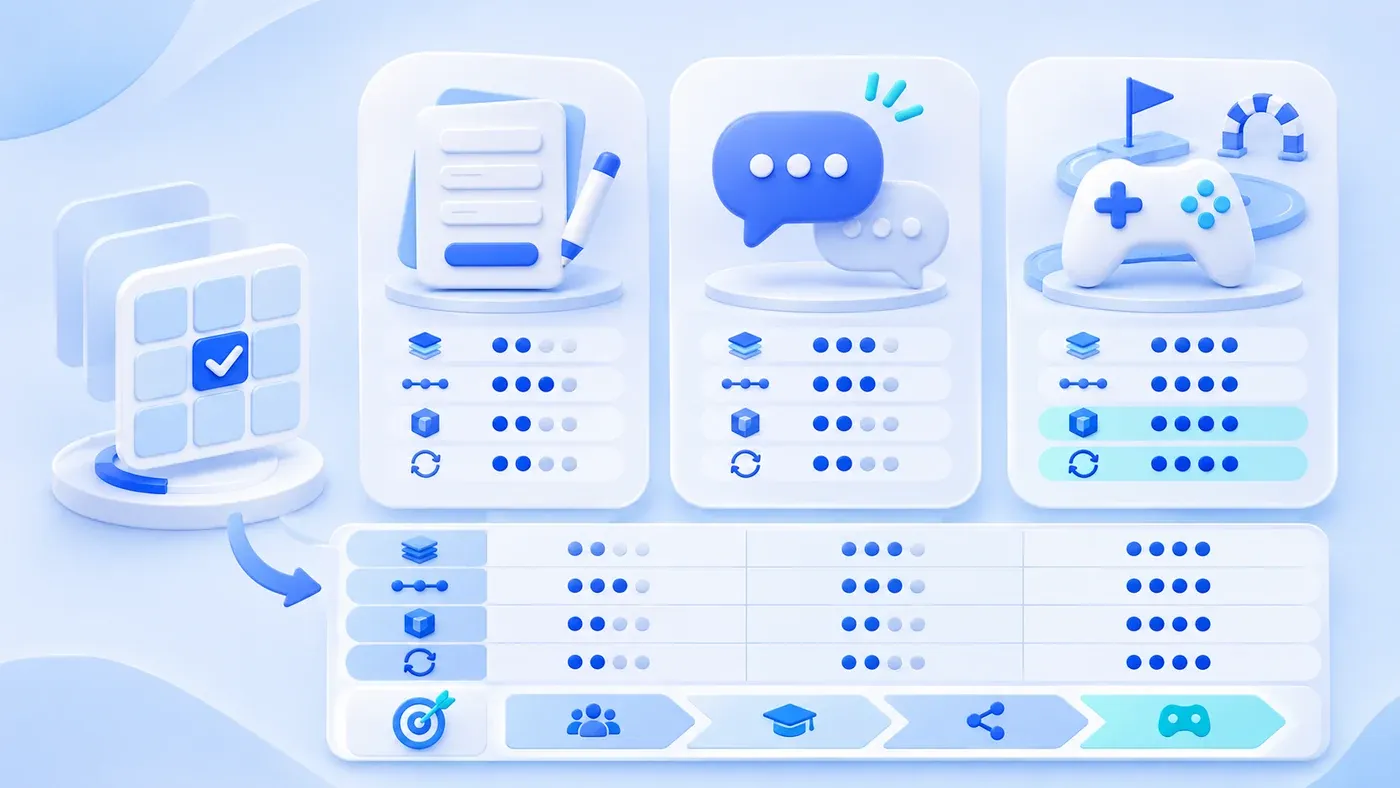
Consider a hypothetical case. The campaign team wants an interactive mini-game because "it spreads and people like playing." Development has two weeks and a limited budget. The real goal is collecting registrations, because venue capacity and follow-up depend on registration details. The game ships on time, plenty of people play, but the signup button sits at the end and few click it. The review concludes: people played the game, but players did not know they were supposed to register.
Interaction formats are not ranked. Forms, Q&A, and mini-games solve different problems, and they differ in how much comprehension participants must invest, how many resources the organizer must spend, and whether the content remains useful after the campaign.
Define the goal before the format
Write down the one primary result: registrations, education, feedback, downloads, check-in, brand reach. Different goals fit different formats.
If the goal is collecting information, a form is usually most direct. If the goal is understanding a complex concept, Q&A or stepped content fits better. If the goal is light experience and sharing, a mini-game may work, but it costs more to build and maintain.
Do not pursue every goal at once. A page that collects registrations, spreads the brand, and educates users often does none of them deeply.
What each format fits
Form: clear fields, short submission path, data flows into follow-up. Fits registration, inquiries, appointments, material requests. The weakness is low engagement; users need existing intent.
Interactive Q&A: a few questions guide users through a topic, with a result that offers advice or a next step. Fits self-checks, selection, education. The weakness is design cost; a wrong answer or meaningless result destroys trust quickly.
Mini-game: interaction, challenge, or light narrative provides experience. Fits warm-up, brand memory, on-site engagement. The weaknesses are long development, device compatibility issues, short content life, and the fact that "fun" does not mean "willing to register."
Comprehension cost and steps
Every extra step loses participants. A form may be three steps: open, fill, submit. Q&A may be five to ten. A mini-game may be ten or more plus learning the controls.
Fewer steps are not always better, but every step needs a reason. If the signup appears only after the game while registration is the goal, the signup should appear earlier, or the game should be built around registration information.
Resources and maintenance
A mini-game needs design, development, testing, assets, and multi-device adaptation, with compatibility issues after launch. Q&A needs questions, result logic, and content review. Forms are lightest but still need field design, privacy notes, and submission handling.
Consider whether the content remains useful after the campaign. A good Q&A can live as a content asset; a mini-game often expires with the campaign; a form can be reused next time.
Sharing does not happen automatically
"Mini-games spread" is an assumption, not a fact. Whether users share depends on whether the result is worth showing, whether sharing carries social currency, and whether participation is simple. Many games get participation with little sharing.
If reach is the goal, design the shareable result page, invitation mechanics, and share copy from the start, and do not rely on prizes or winning promises. Prizes bring participation but not necessarily brand memory or qualified registrations, and they raise rules and compliance issues beyond this article.
A selection matrix
Format | Fits goals | Participant steps | Development and design | Maintenance | Common failure |
|---|---|---|---|---|---|
Form | Registration, inquiry, appointment | Few | Low | Low | Too many fields; no feedback after submit |
Interactive Q&A | Education, self-check, selection | Medium | Medium | Medium | Unsupported results; leading questions |
Mini-game | Warm-up, experience, on-site | Many | High | Medium-high | No next step; compatibility problems |
The matrix is not absolute. With enough resources and a clear goal, a mini-game can work well; with limited resources and a registration goal, a form is often more reliable.
Budget and deadline constraints
Campaign dates are usually fixed. Work backward from the date, subtract design, development, testing, content review, and launch buffer, and what remains is the room for choosing a format. With two weeks left, a mini-game may not fit even one round of real-device testing; a form or Q&A is more likely to ship and pass acceptance.
Assign maintenance before launch. After the campaign, who takes the page down, exports the data, handles leftover links, and answers user questions? Without an owner, even a good interaction leaves an unmanaged page and unanswered promises behind. Estimate the cost of changes, not only the first build. A game that needs a new level for every regional variant may cost more than a question set that reuses the same structure. Choose the format your team can still support a month later.
A late launch is its own failure.
Clarify the Campaign Goal Before Choosing a Format
[Campaign format selection checklist]

1. Goal
- What is the one primary result:
- Does the chosen format serve it directly:
- Are too many goals being pursued at once:

2. Participants
- How many steps, and is each necessary:
- Where does the primary action appear:
- Does the result page state the next step:

3. Resources
- Are development, design, testing, and assets sufficient:
- Is multi-device compatibility planned:
- Will content be maintained after the campaign:

4. Reach
- Is sharing designed from the start:
- Are prize promises avoided as the mechanism:
- Are "played" and "registered" counted separately:
Write the one goal and use the matrix to rule out two unsuitable options. If the team still chooses the most complex format, at least name who owns the resources and maintenance. The scope of campaign interaction projects can be discussed within content and interactive support.
How content must be restructured per platform is in publishing one piece everywhere is not simple; the whitepaper landing page path is in why enterprise whitepapers generate leads.
For a quiz, refine the questions and result explanations. Every format still needs loading, failure and re-entry checks.
