
Key takeaway
State what each question learns or helps the user judge. Options should be mutually exclusive and cover common cases. Results explain the basis and applicable conditions, without psychological diagnosis or invented research. A quiz can help users self-check, choose, or learn; more personal data is not the goal.
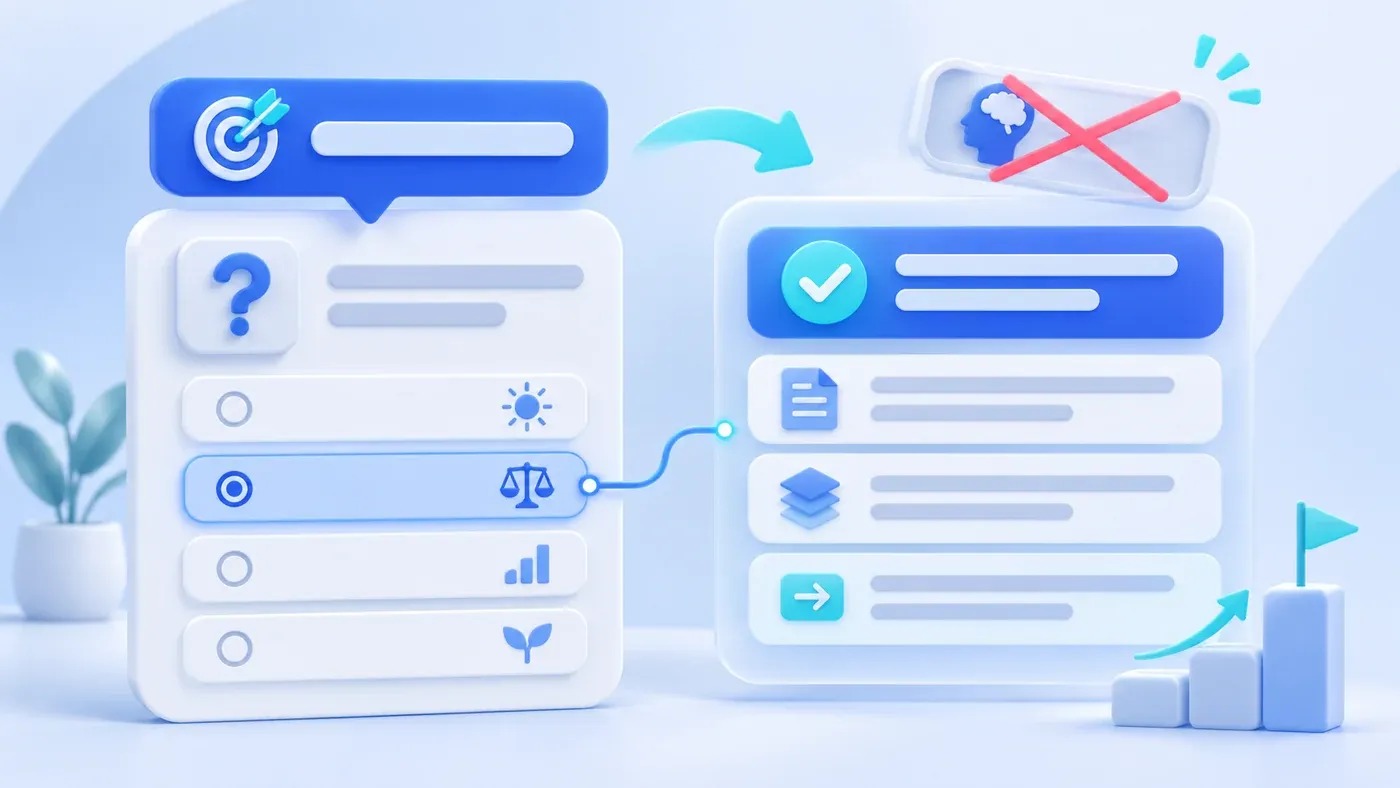
Consider this hypothetical quiz project. Its participation and lead outcomes are illustrative, not results from a real campaign.
Marketing builds an industry quiz: five questions, ending with "you are the steady type." Participation is decent on launch day, and some people share results. A week later, the review asks: what did the company get? No leads, no content feedback, no idea what participants actually care about. What did users learn? Besides a label, almost nothing.
A quiz can be a valuable interactive format, but the value does not come from "taking a quiz." It comes from whether the questions help users answer a real question and whether the result offers a next step.
Customer counts, team size, and question counts in the examples only demonstrate how answers map to a result. They are not general CRM-selection thresholds; validate the actual rules with the intended audience.
Ask what the quiz is for
Name at least one concrete purpose:
- Help users judge which solution fits their business.
- Help users check problems in their current process or website.
- Help users learn a set of industry concepts or compliance points.
- Warm up an event so participants arrive with questions.
If the purpose is only "more interaction" or "collect leads," the quiz easily becomes entertainment. Entertainment is allowed, but it needs different design goals and should not pretend to be a professional assessment.
Three valuable quiz types
Self-check: users answer about their own business and receive a problem list or improvement suggestions, such as "does your website have these five basics?"
Selection: based on scenario, scale, and budget, the quiz returns suitable solution types and reasons. The result is a set of conditions, not a product advertisement.
Learning: each question teaches a point, with an explanation and further reading after answering. It is interactive content, not a personal conclusion.
The three can combine, but each question's purpose must be clear.
Questions and options
Be specific. "How digital is your enterprise" is too broad; "do you manage customers in spreadsheets or a system" is answerable.
Options must be mutually exclusive. Do not let one user fit two options, and do not omit common cases. "Other, please specify" or "not sure" can help, but do not stuff every unknown into one option.
Keep three to five options. More is tiring; fewer forces inaccurate choices. Know what result each option maps to at design time, not when the result page is written.
Avoid leading. Questions should not hint at a "correct answer" or push users to choose an option for a better result. If the result page collects contact details, separate it from answering; do not force information exchange to see the result.
Result explanations must not be invented
A result states three things: the conclusion, which answers support it, and the applicable conditions.
For example: "Based on your answers on customer count, follow-up method, and data source, you are better served by standardizing the customer table before adopting a CRM. This applies to businesses with fewer than 200 customers and no more than five salespeople; at larger scale, the conclusion may differ."
Do not diagnose personality. Do not claim "research shows 80 percent of companies" without a checkable source. Without survey data, say "common situation" or "our judgment," not a statistical finding.
Information collection and privacy
A quiz may collect answers, but state the purpose: improving questions, generating results, follow-up contact. Collecting contact details requires a separate explanation of purpose and retention, never a pre-checked box.
Sensitive information—identity numbers, health, detailed finances—should not be collected through a quiz. If results are publicly shareable, state the scope.
A hypothetical question sample
Question | Purpose | Options | Result mapping |
|---|---|---|---|
Where do customer records mainly live? | Judging data foundation | Paper / personal spreadsheet / shared spreadsheet / business system / not sure | First three suggest standardizing first; system option goes to the next step |
Who updates customer records? | Judging ownership | One person / each salesperson / nobody / unclear | If nobody, the result prioritizes assigning ownership |
How often do duplicate customers appear? | Judging merge need | Weekly / monthly / rarely / never measured | Frequent duplication points to merging and master-data rules |
Every option maps to a judgment, and the result is not "you are a type" but "what to handle next."
Result pages and sharing
The result page is what participants most want to share and where information most easily leaks. The share card shows the conclusion and a little of the basis, without names, companies, contact details, or answer-by-answer data. Before sharing, users should see what the card will look like.
Do not force contact details before showing the result. Give the result first, then invite contact details for a more detailed recommendation. Participants who decline still gain something, and those who share details know what they receive in return. Keep the result wording modest: describe the answers and the conditions, not the person. A quiz is not a diagnosis, and the share card should not read like one. Test the card on a phone before launch.
Check Each Question, Choice and Result
[Enterprise quiz question checklist]

1. Purpose
- What judgment or learning does the quiz support:
- Can each question's purpose be stated in one sentence:
- Does the result give a next step:

2. Questions and options
- Are questions specific and answerable:
- Are options exclusive and covering common cases:
- Is the option count moderate:
- Does each option map to a clear result:

3. Results
- Are the basis and applicable conditions explained:
- Are psychological diagnosis and invented research avoided:
- Is the result kept from becoming a product ad:

4. Information
- What is collected, why, and for how long:
- Are contact details separate and consented:
- Is sensitive information avoided:
Write three questions and their results, then ask five target users to try. If they cannot say what to do next after finishing, the questions are not carrying a real task. The scope of enterprise interactive content can be discussed within content and interactive support.
B2B and B2C content differences are in how B2B content marketing differs from B2C; local business content scenarios are in where a local business can use AI content.
If the questions do not fit the goal, compare the campaign formats again. When a quiz fits, place it within the landing-page action order.
