
Key takeaway
Each conclusion keeps its source link, publisher, check date, and excerpt, labeled as official statement, third-party report, or AI inference. List unknowns instead of filling them with inference. Record the check date and applicable period. Never claim a partnership or verified capability from public material.
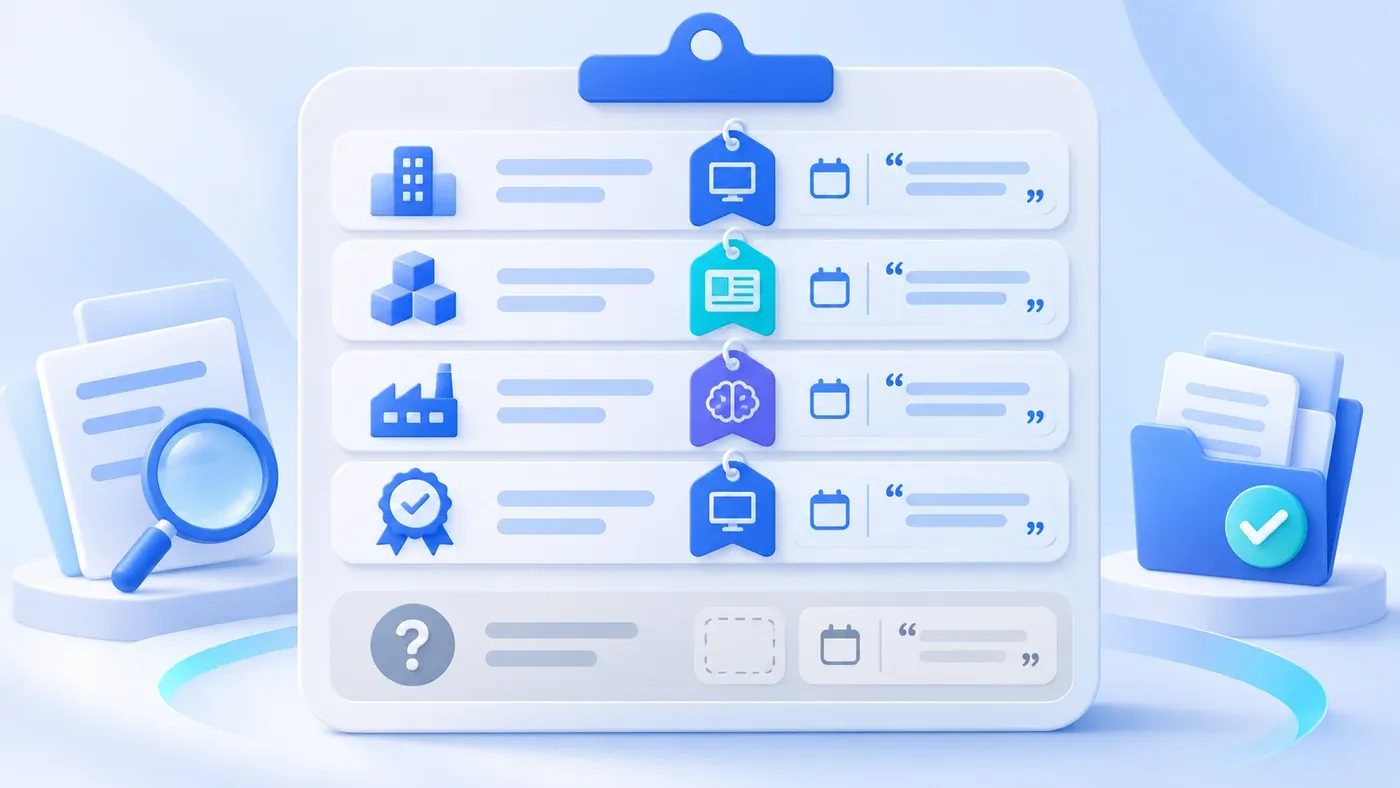
Take this illustrative scenario. Procurement asks AI to compile public information about a candidate supplier. AI quickly produces a report: founding year, product lines, annual capacity, certifications, major customers, all neatly organized. In the review meeting someone asks where the capacity figure came from. The report has no link. Asked about the major-customer sentence, AI admits it was inferred from news.
The report has not yet been verified. It blends three kinds of information: what the supplier's website says, what third-party media report, and what AI inferred. The three carry different credibility and lead to different next actions. Mixed together, they cannot be judged.
Public research also needs an evidence table
Public information is not casual reading. It informs supplier screening, partnership decisions, and quote comparisons. Every conclusion should return to an original and answer: who said it, when, what exactly was written, and whether it is fact or inference.
AI can collect, excerpt, and group. People define the evidence structure. Otherwise a longer report is merely harder to verify.
At least five fields per record
- Source link: the full URL, not a search page or short link.
- Publisher: official website, industry association, media, trade show organizer.
- Check date: the day the page was actually opened.
- Original excerpt: the sentence supporting the conclusion, in the original language, not rewritten.
- Evidence type: official statement, third-party report, or AI inference.
Add two more: location (page title, section, paragraph) and applicable period (which year or version the information describes). Public pages often omit an update date, so at least record when you checked.
Three source types, never merged
Official statements: content the supplier publishes: company profile, product pages, certification claims. It still needs checking—a certificate number can be verified with the issuing body—but label it "supplier's own statement" in the table.
Third-party reports: media, industry research, trade show material, tender notices. A third party may repeat the website or conduct its own reporting. Record publisher and date, and distinguish "reported" from "verified."
AI inference: a judgment AI draws from several inputs, such as "expanding capacity based on job postings." Inference belongs in an analysis column, not the fact column, and cannot be the only basis for a conclusion.
Label these in words, not color alone. Color disappears in print or export.
Unknowns matter more than filling gaps
AI tends to fill blanks with plausible answers. If the website does not state capacity, it may estimate from factory area and industry averages. That number is the most dangerous because it looks like fact.
List an "unknown/to verify" column instead: capacity not disclosed; certification page unreachable; major customers not public. Unknowns drive next actions: email the supplier, check the issuing body, confirm at a trade show.
An unknown is not a report defect; it is an honest research state. A report that lists unknowns is more credible than one that is complete everywhere.
Aging and change
Public information changes. A supplier may update product lines, gain certifications, or remove old news. Record check dates and state "as of" beside key conclusions.
For long evaluations, recheck important items. Rechecking is not rewriting the report; it is confirming the source is still reachable, the content has not changed, and the conclusion still holds. Keep a change record: what it said, what it says now, when discovered.
A hypothetical evidence table
Conclusion | Source link | Publisher | Checked | Evidence type | Excerpt | Status |
|---|---|---|---|---|---|---|
Founded in 2012 | Hypothetical About page | Supplier website | 2026-11-16 | Supplier statement | "Founded in 2012…" | Recorded |
Three production lines | Hypothetical product page | Supplier website | 2026-11-16 | Supplier statement | "three production lines…" | Recorded |
Annual capacity 50,000 units | — | — | 2026-11-16 | Unknown | Not disclosed | To verify |
ISO 9001 certified | Hypothetical certificate lookup | Certification body | 2026-11-16 | Third-party verifiable | Certificate number and scope | Verified |
Major customers include a brand | Hypothetical industry news | Trade media | 2026-11-16 | Third-party report | "According to industry sources…" | Awaiting supplier confirmation |
Keep "awaiting supplier confirmation" separate from "to verify": the first needs the supplier to respond, the second you can check yourself. Merging both into "pending" leaves nobody knowing what to do.
Keep public evidence separate from internal information
Public research uses public sources only. Internal prices, customer lists, contract terms, and undisclosed capacity figures should not enter the evidence table for convenience, and AI should not copy them from internal systems into an external report.
If the assessment needs internal information, keep a separate internal record with its source, access scope, and permitted use. Report externally from the public evidence only, and state which conclusions still need internal verification. Mixing the two makes it impossible to say what can be shared.
Keep the two records physically separate.
Attach Evidence to Each Supplier Claim
[Supplier public-information evidence checklist]

1. Sources
- Does each conclusion have a full link and publisher:
- Is the actual check date recorded:
- Are original excerpts and locations kept:

2. Evidence type
- Are supplier statements, third-party reports, and AI inference labeled separately:
- Does inference appear only in analysis:
- Are externally verifiable items such as certificates checked:

3. Unknowns
- Are undisclosed or missing items listed separately:
- Is the next verifier named:
- Was any gap filled with inference:

4. Aging
- Do key conclusions state their applicable period:
- Is a recheck scheduled for long evaluations:
- Are content changes recorded:
Take a supplier under evaluation and fill five conclusions plus two unknowns. If every line opens to an original with the quoted words, the table is more useful than a polished report. Public information is not proof of partnership or delivery capability; it is input to assessment. How customer communication keeps exact wording is covered in the customer email checklist discussion within AI applications and workflows; this article covers public evidence only. The scope of public research and AI workflows can be discussed within AI applications and workflows.
Evaluating an AI vendor's demo against delivery is covered in how to tell a demo from real delivery; how content becomes easier for AI to cite is in what content AI is more likely to cite.
For claims found in customer emails, separate quotations from inference. Before handing them over, check that the summary keeps the conditions.
