
Key takeaway
Separate static explanations from live records. Policies, specifications, and processes come from the knowledge base; stock, order status, and project progress come from business systems. A live answer states its source system, query time, and data cutoff. If a query fails, say so; never pass old data off as current.
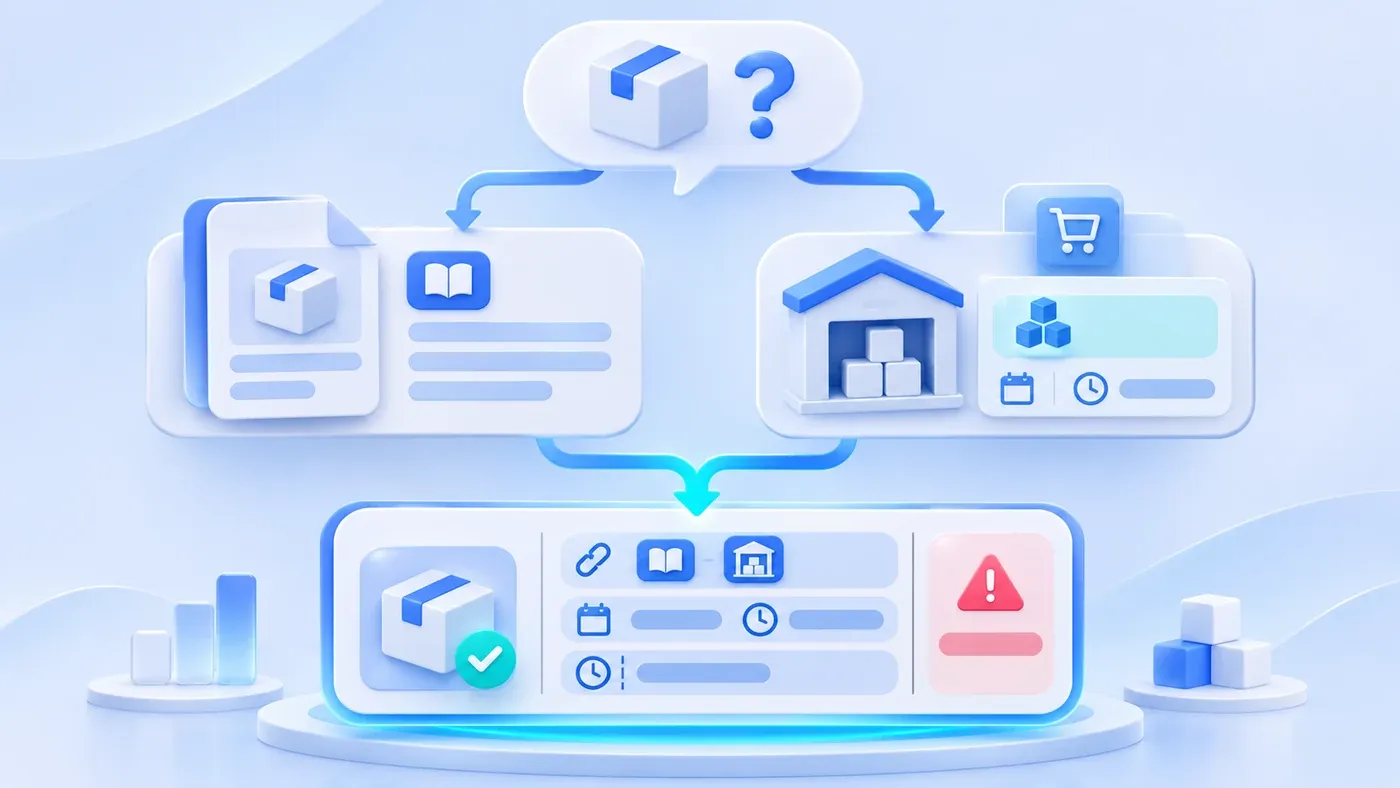
Consider a hypothetical case. A customer asks: "Is this in stock? Can you ship next week?" AI finds "in stock" in the product material and answers yes, ready to arrange. The customer orders, and the warehouse finds the item has been out of stock for two weeks. A static supply description may be out of date and cannot establish the current stock level.
Static documents in a knowledge base explain what something is and how it works. A document snapshot alone cannot establish the current quantity or workflow state. Stock, order status, project progress, and balances change constantly and must come from business systems.
Static explanations and live records
Static explanations: product specifications, service policies, process steps, FAQs. They change slowly, have versions, and belong in a knowledge base.
Live records: stock quantities, order status, shipment progress, project tasks, account balances. They change by the minute or hour, and their authoritative source is a business system, not a document.
AI must classify the question first. "How long is the warranty" queries the knowledge base; "does this machine exist in stock now" queries inventory. Mixing them produces "the document says yes, reality says no."
Three things a live answer carries
Source system: inventory, orders, or project management. The user knows whom to trust.
Query time: when the lookup happened. Stock ten minutes ago and stock yesterday mean different things.
Data cutoff: how current the business system's own data is. Some inventory systems sync hourly, so the query time is now while the data may be two hours old.
For example: "The inventory system shows 3 units available as of 10:05 today; the system syncs every 30 minutes." That is far more useful than "in stock."
The path for live data
AI should not connect to production and query freely. A safer path calls an interface provided by the business system or queries a read-only view within business rules.
The interface returns structured fields: quantity, status, update time. It should not return prose for AI to parse, because parsing adds new errors.
If no interface exists, a read-only view or scheduled sync can serve temporarily, but the answer must state the delay. Pretending to be real time without an interface is the most dangerous approach.
Refresh, cache, and old data
For speed, the system may cache query results. Cache needs an expiry and the answer must show the actual query time, not when the page opened.
In a continuing conversation, do not reuse a stale stock result. When the user asks "what about now," query again or state clearly that this is the earlier result.
Historical data is useful but must be labeled historical. "Three units when checked last Friday" is not current stock.
When the query fails
On timeout, maintenance, or insufficient permission, say the query failed instead of falling back to "usually in stock."
Acceptable: "The inventory system is temporarily unreachable, so current stock cannot be confirmed. Try again later or contact the warehouse." Unacceptable: "Usually in stock, you should be able to order."
Failures can offer next steps: retry, warehouse contact, or expected recovery time if the system provides one. Do not promise a recovery time unless the business confirms it.
Do not invent real-time integration
When an answer says "real-time stock" or "live progress," it must be true. If data syncs daily, say daily. If it comes from a document saying "in stock," it is not an inventory lookup.
This matters especially in demos: the demo environment may hold test data, and the customer must not be told "this is our live system."
A hypothetical answer comparison
Question | Bad answer | Acceptable answer |
|---|---|---|
Is this in stock? | Yes, the product material says in stock. | The inventory system shows 3 units available as of 10:05; data syncs every 30 minutes. |
Where is my order? | It should have shipped. | The order system shows shipped and collected by the carrier; queried at 10:08. |
What is the project status? | Progressing well. | The project system shows requirements confirmed and development underway, last updated November 14; completion percentage is not maintained in the system. |
What is the account balance? | The balance is sufficient. | The finance system shows the available balance as a hypothetical figure; data through yesterday 24:00, and today's receipts are not yet posted. |
The acceptable answers may not satisfy the user, but they make uncertainty explicit. The user knows whether to order and whether to confirm again.
When the inventory system and the order system disagree, do not pick the one that looks newer. Present both sources, their times and definitions, and explain that the gap may come from reservations, in-transit orders, or sync delay. State explicitly that the two numbers measure different things. If it cannot be resolved, hand over to the warehouse or order owner rather than letting AI guess; do not average them.
State which source is authoritative for which question.
Check Live Answers for Source, Time and Failure
[AI live data answer checklist]

1. Question classification
- Is the question static explanation or live record:
- Do live questions route to the right business system:
- Is product material kept away from stock and status answers:

2. Answer labels
- Is the source system stated:
- Are query time and data cutoff shown:
- Is sync frequency or delay explained:

3. Failure and cache
- Does a failed query say it failed:
- Is "usually" kept out of answers:
- Does cache expire, and is actual query time shown:

4. External wording
- Is "real time" used only when true:
- Is demo data labeled as demo:
- Is a retry or human confirmation offered:
Take the most-asked live question—stock or order status—and check whether the answer carries a source and time. If it says only yes or no, the chain is not connected. How to bound read-only database access is covered in the read-only query topic; interface levels and write boundaries are in how AI connects to ERP and OA. The scope of live data queries and AI workflows can be discussed within AI applications and workflows. Action permissions and approval are in AI agent permissions, approval, and human takeover.
Start live lookups with read-only database access. Organize static product material by model and version so the two answer sources stay distinct.
