
Key takeaway
Step extraction drops conditions and exceptions most easily. Separate the action, the condition under which it applies, and the exception when it does not. An SOP states applicability, steps, exceptions, owner, and source clause. Conditions must be judgeable, and exceptions need a path, not 'as appropriate'.
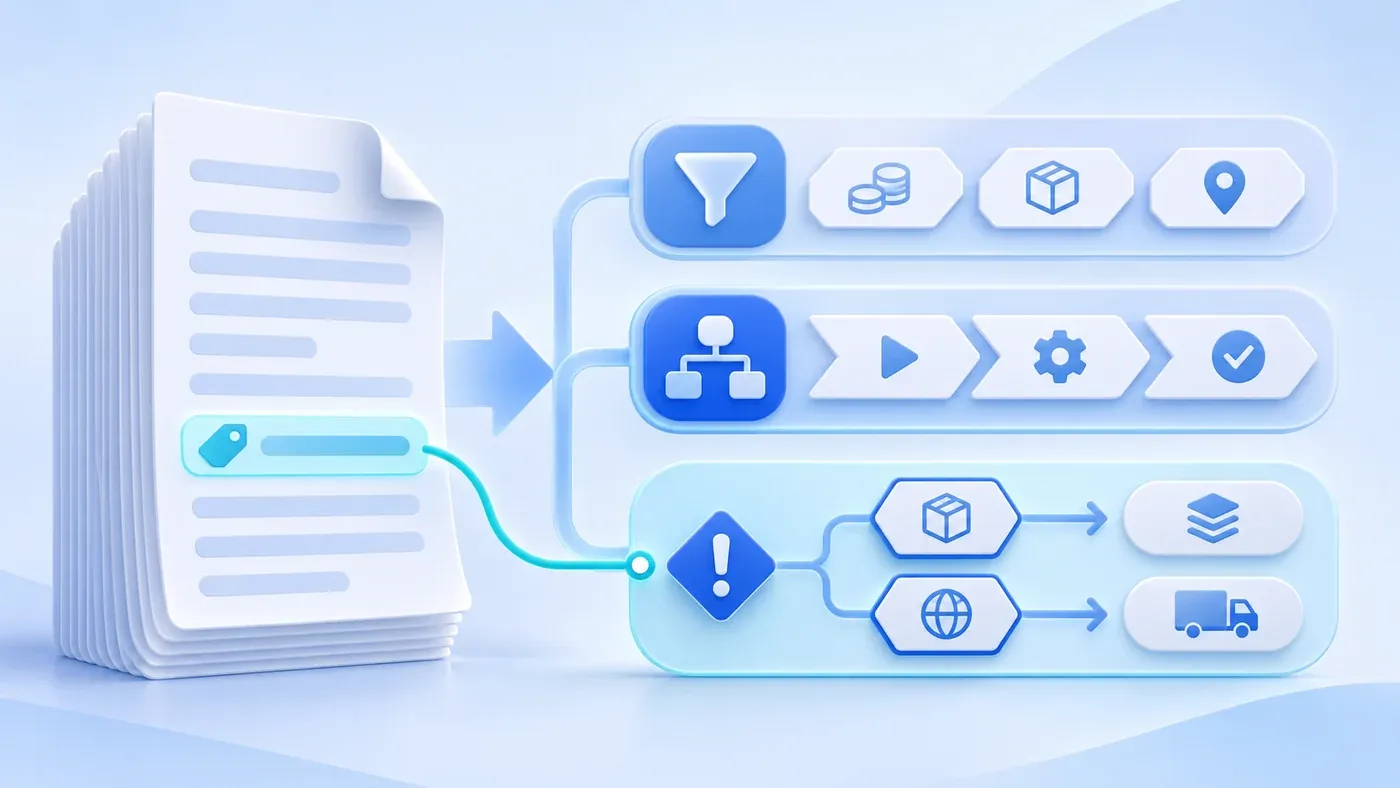
Take this illustrative scenario. HR hands AI a 40-page expense policy and asks for an SOP frontline staff can follow. AI outputs ten steps: log in, choose expense type, enter amount, upload invoice, submit for approval. It reads cleanly. A new employee follows it, and the first sample purchase gets stuck: the policy says sample purchases do not go through reimbursement but through a purchase request, and the guide omits that sentence.
AI did not misread. It extracted the steps but did not carry along the conditions under which each step applies and the cases where it does not. Compressing a long document into steps loses conditions and exceptions first.
Why step extraction loses conditions
In policy documents, an action usually carries qualifiers: approval above a certain amount, which regions apply, which order types are excluded, how holidays are handled. Step extraction tends to keep verbs and order and treat qualifiers as decoration.
To the writer, qualifiers are supplementary notes; to the executor, they decide whether and how to perform the step. Missing one condition turns an executable guide into one that merely looks executable.
Separate three kinds of sentences
Break the source into sentences and label each:
Action: who does what. For example, "submit the purchase request."
Condition: when the action applies. For example, "amount above 500," "domestic suppliers only," "submitted before 17:00 on a workday."
Exception: what happens when the condition fails or another rule applies. For example, "sample purchases are excluded and follow the purchase request process," "overseas orders are out of scope."
One sentence may contain all three; split them. Once split, conditions and exceptions are not treated as modifiers and lost during compression.
Five parts of an SOP entry
- Applicability: when the guide applies, to whom, and during what period.
- Steps: ordered actions, each with input and result.
- Exception handling: what is out of scope, which path it follows, whom to ask.
- Owner: who executes, who approves, whom to contact when something breaks.
- Source clause: the section or clause in the original document for checking and updating.
For a short frontline card, five parts can compress into three lines, but the exception and source cannot be dropped.
Write conditions as judgeable statements
"Large amount" cannot be judged; "amount above 500" can. Replace "recently," "special circumstances," and "when necessary" with judgeable criteria or name the person who judges.
State whether multiple conditions are AND or OR. "Amount above 500 and overseas order" differs entirely from "amount above 500 or overseas order." AI tends to drop the conjunction during compression; check connectives specifically.
Exceptions need a path
An exception cannot say "handle separately." It states which process applies, to whom it goes, what materials are needed, and how long a result takes. If the source does not specify, mark "not specified in the source; confirm with this role" rather than inventing a process.
Processes with many exceptions can use a separate exception table: situation, criterion, handling path, owner. Keep the main guide short and attach the table.
Versions and sources
Policies change. The guide states the source document's name, version, and date, and is checked when the policy updates. A guide without a source soon has no one knowing whether it still applies.
If AI draws from several documents, cite each line separately. Do not merge into "according to company policy"; merged, it cannot be checked or traced when documents change.
A hypothetical example: one step in an expense policy
Source clause | Bad compression | Acceptable guide |
|---|---|---|
Reimbursements above 500 require manager approval. Sample purchases do not use reimbursement and must submit a purchase request. | Enter the amount and submit for approval. | Applies to: ordinary reimbursements of 500 or less. Steps: enter amount, upload invoice, submit. Exceptions: above 500 requires manager approval; sample purchases go through a purchase request. Source: Expense Policy v3, clause 4.2. |
Bad compression is not a wrong sentence; it is an incomplete one. It lets a document enter a process it should not, and by the time an approver returns it, a round of time is gone.
Who confirms conditions and exceptions
The person writing the guide cannot decide conditions and exceptions alone. Every "except," "only," and "above" needs confirmation from the business owner responsible for it, especially clauses involving money, permissions, safety, and external commitments.
Record the version and date in the guide. When the policy changes, update the source first, then the guide, then notify frontline staff. Sample a few guides periodically against the source to check they still agree. If guide and source conflict, the source prevails and the guide is corrected immediately. Keep the confirmation with the guide's version history.
A guide without a named confirmer is only one person's reading of the policy, however clean its steps.
Name the confirmer and the date in the guide itself. It answers future questions about who agreed.
Check Conditions and Exceptions Before Handoff
[Long-document to SOP checklist]

1. Structure
- Does each entry include applicability, steps, exceptions, owner, and source:
- Are actions, conditions, and exceptions labeled separately:
- Does it cite the source section or clause:

2. Conditions
- Are amount, time, region, and type conditions judgeable:
- Is AND/OR explicit:
- Are vague words replaced or assigned to a judge:

3. Exceptions
- Does each exception have a handling path and owner:
- Are unspecified exceptions marked for confirmation instead of invented:
- Are exception-heavy processes given a separate table:

4. Maintenance
- Does the guide state the source version and date:
- Who checks the guide when the policy updates:
- Which prevails when guide and source conflict:
Take your most-used policy, have AI produce a one-page SOP, and compare it with the source looking for "except," "only," "above," and "separately." One missing exception means the guide is not ready for frontline use. How to organize policies and processes into knowledge base material is covered in what data an enterprise knowledge base needs to start; the difference between FAQ and knowledge base is in FAQ versus knowledge base. The scope of document organization and human confirmation can be discussed within AI applications and workflows.
Each instruction should lead back to its source. Turn easily missed exceptions into acceptance questions that test actual output.
