
Key takeaway
A chat thread is not a brief. Organize it into goals and audience, binding constraints, deliverables, decided items, disputed items, and open questions, keeping key quotes, speakers, and timestamps. Separate decisions from guesses and preferences. Do not turn one person's preference into team consensus.
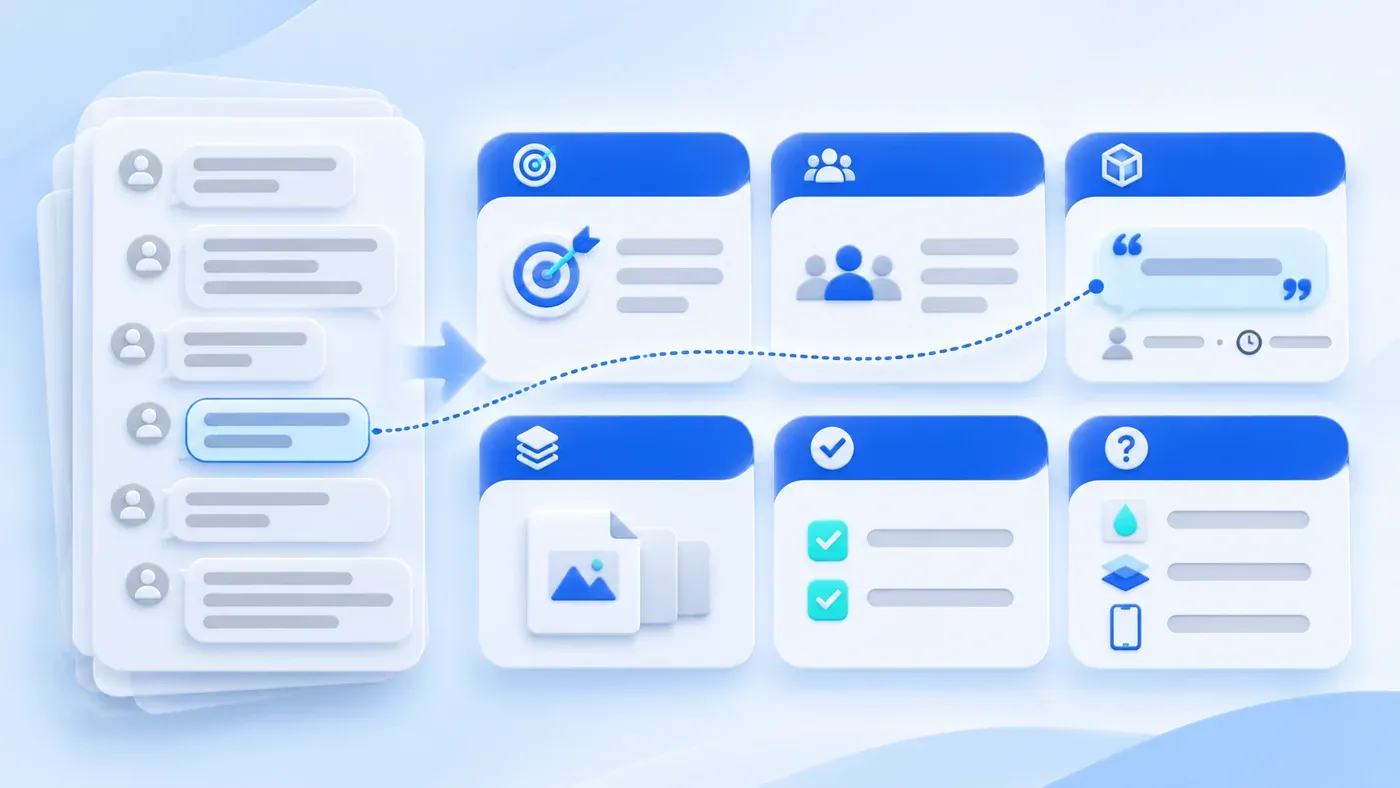
Suppose the following happens. A designer receives a page redesign task. The contact forwards 300 group-chat messages and says the requirements are all in there. The designer spends two hours extracting goals, reference styles, and a few features, then produces a first draft. The boss responds: I said in the group not to use blue. Why is the main color still blue?
The information was all there, but "all there" is not "usable." Chat is divergent: trial balloons, jokes, repetition, and changes over time. A design brief converges the process into decisions and explicitly marks what has not converged.
A chat thread is not a brief
Forwarding the thread makes the designer do work the contact should have done: deciding which sentence is a decision, which is a joke, and which was later reversed. The designer does not know the reporting lines or decision rights, so one person's preference easily becomes team consensus.
Organizing is not deciding for the team. It is arranging what happened into the structure design needs, so gaps and disagreements become visible.
Six sections
Goal: what business problem the design solves, and what success looks like. Not "make it look better," but "a first-time customer understands what we do on the first screen and knows how to contact us."
Audience: who looks, in what setting, and what they care about. B2B buyers and consumers need different information density and trust signals.
Constraints: what must be satisfied. Brand colors, logo rules, required credentials, forbidden elements, technical limits, launch date. Constraints quote the source or reference a document.
Deliverables: how many pages, which sizes, what format, whether mobile is included, whether editable source files are required. Not just "design it."
Decided: what the team has settled, including rejected directions. Rejected items must be as visible as decisions, or the designer will propose something already ruled out.
To confirm: what remains open, who decides, and when an answer is needed. Do not disguise open items as decisions.
Keep quotes, speakers, and timestamps
Key constraints quote the original and note who said it and when. For example: "No blue; distinguish it from the old version"—the owner, in the group on November 3.
A quote preserves tone and scope. Paraphrase loses qualifiers: "no blue for now" differs from "no blue." Time matters too: a preference from three months ago may have changed and needs confirmation.
When the chat contains files, links, or references, note the file name and which item it supports. The brief need not include the whole thread, but key evidence must be findable.
Separate decisions, preferences, and guesses
A sentence can be three things:
Decision: someone with authority has decided, or the team agrees. Put it under "decided" with the basis.
Preference: one person's taste, such as "I personally like a livelier look." Put it under "preferences/references," attribute it, and do not treat it as binding.
Guess: a guess about users or results, such as "I think customers will like big images." Put it under "assumptions," with how it will be validated or who confirms.
Mixed together, the designer cannot tell what is binding and what is discussable. Separated, the brief neither misses hard constraints nor promotes personal taste into an order.
List disagreements explicitly
Chats often say "let's use blue first," "but the boss said no blue," "then let's do a version and see." That is not a decision; it is a disagreement temporarily shelved.
The brief states: what the disagreement is, each side's reason, the temporary approach, who has the final call, and when it must be settled. The designer can proceed on the temporary approach knowing it is not final, avoiding rework after a late reversal.
If the disagreement affects the overall direction—brand color, page structure—resolve it before design starts. If not, proceed in parallel but confirm before delivery.
A hypothetical brief
Section | Example content |
|---|---|
Goal | Let a first-time procurement manager understand the product range and be willing to inquire from the first screen |
Audience | Manufacturing procurement and equipment engineers, mostly desktop, some mobile |
Constraints | No blue as the main color (owner's words, November 3); logo and two credentials required; no customer logos |
Deliverables | Home and product detail pages, desktop first with mobile adaptation; editable source files |
Decided | Keep the inquiry button on the first screen; no autoplay carousel; the earlier large-image concept is rejected |
To confirm | Final main color (owner by November 10); whether an English version is needed (sales confirms) |
Preferences | Marketing prefers a livelier style; reference only |
Assumptions | Procurement cares most about lead time and cases; to be validated in interviews |
This fits on one page. The point is that every section has content and "decided" is not mixed with "to confirm."
Hand Designers a Brief They Can Act On
[Chat-to-design-brief checklist]

1. Completeness
- Are goal, audience, constraints, and deliverables all present:
- Do key constraints quote the speaker and date:
- Do deliverables state pages, sizes, formats, and mobile needs:

2. Separation
- Are decisions, preferences, and guesses separated:
- Are rejected directions written down:
- Do open items name the decision maker and deadline:

3. Disagreement
- Does each current disagreement list reasons and a temporary approach:
- Have direction-level disagreements been resolved first:
- Is the temporary approach marked as not final:

4. Versions
- Does the brief have a date and version:
- Are changes to decisions communicated to the designer:
Organize the chat from your latest design task into the six sections, then ask the designer to restate the goal and constraints. If the restatement contains something never said, a guess entered the brief; if it misses "what not to do," rejected items are not visible enough. Turning customer email into a requirement checklist is a neighboring but different problem; this article covers the design brief. The website and interaction design process can be discussed within corporate websites and independent sites.
The full method for AI requirements documents is in how to write an AI requirements document; how to review AI output is in how AI output should be reviewed.
For a long email, start with an open requirement list. Any promise in the resulting web copy needs a pre-publication fact check.
