Key takeaway
Website timelines shift mainly because of four dependency chains, not coding speed: ready specs, cleared cases and bilingual terms; consolidated internal sign-off; domain, ICP, WeCom or WhatsApp access and API docs; and legacy URL mapping with a cutover window. Avoid fixed-week promises; freeze prerequisites first.
Most corporate website projects open on an upbeat note: page lists seem clear, visual references are shared, and both sides pencil in a target launch month. Once production starts, however, dates often slip. Layouts wait on verified specifications, messaging buttons stall over admin permissions, or two days before cutover someone remembers hundreds of legacy blog links were never mapped.
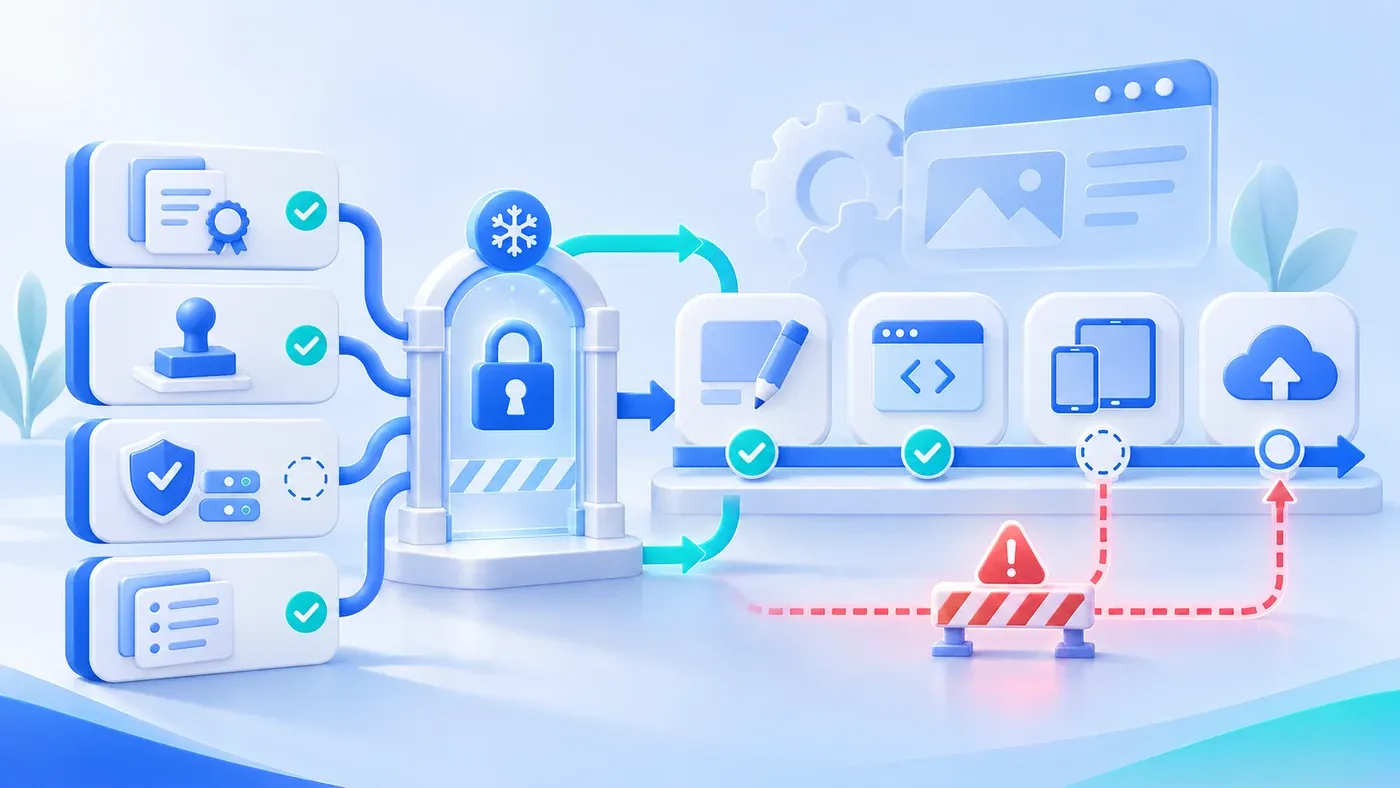
Website timelines rarely slip because engineers suddenly write code slower. Actual delivery speed is governed by four upstream dependency chains outside the codebase: readiness of business materials, internal review and sign-off cadence, external compliance and account integrations, and legacy site migration plus launch windows. Because these chains span multiple internal teams and third-party approvals, any fixed "guaranteed X-week launch" promise made before inspecting them usually ends in rushed testing or expensive rework.
Why Estimating Schedules by "Page Count" Alone Misleads Teams
In our delivery process, building a website moves from initial scoping and requirements planning through design, development, QA, deployment, and handover. That looks linear on a timeline chart, yet every stage trades concrete inputs back and forth:
- Layout stability depends on real copy: Whether a product page shows three bullets or twenty technical parameters changes card sizing, comparison tables, and mobile line wrapping.
- Integration testing depends on live access: Until registrar logins, chat admin rights, or API sandboxes are ready, developers can only wire buttons against assumptions.
- Downstream speed depends on early alignment: Fast coding only magnifies rework if the final decision-maker challenges navigation or positioning right before launch.
Estimating solely from "roughly a dozen pages" hides these cross-team handoffs—causing delays to surface all at once near launch.
The Four Dependency Chains That Govern Website Schedules
- Materials and permissions
- Prototype and content approval
- Accounts and external prerequisites
- Integration and launch checks
1. Upstream Material Dependencies: Specs, Case Clearances, and Bilingual Terms
Timelines often stall not from zero materials, but from files assumed ready that cannot actually go live without internal verification:
- Unverified product specs and scope boundaries: Sales decks often emphasize broad claims, whereas public pages require product or engineering leads to verify exact parameters, limits, and retired models. Changing core facts after templates are built forces layout and mobile QA rework.
- Uncleared client case studies and screenshots: Teams frequently slate showcase projects at kickoff, only to learn later that written consent for client names, logos, or screenshots was never secured. Legal sign-offs often take longer than coding the gallery.
- Lagged bilingual terminology review: Bilingual sites cannot ship with untranslated Chinese paragraphs inside an English template or rough machine translations. Per Google Search Central's guide on managing multi-regional and multilingual sites, each language needs distinct URLs without mixed-language fallback copy. Without a designated bilingual reviewer to lock product terms, localized pages must wait or launch in separate batches.
2. Internal Approval and Consolidated Feedback Cycles
Even complete assets stall when internal feedback lacks structure:
- Conflicting serial edits across teams: Marketing rewrites headlines on Monday, sales reshapes solution tiers on Wednesday, and technical reviewers alter diagrams on Friday—turning production into a waiting room for internal consensus.
- The late-entering final approver: When coordinators approve wireframes and copy, only for an executive sponsor to review the staging site right before launch and overturn core positioning or menu hierarchy, design, engineering, and localization must repeat together.
3. External Compliance Prerequisites and Account Integrations
These blockers sit completely outside coding speed—even a finished build cannot serve public traffic until external gates clear:
- Domain ownership, real-name verification, and ICP filing: For a Mainland China deployment, confirm the applicable filing or permit, entity materials, and current verification process with the intended provider. The record-filing measures are background for that check, not a project-specific eligibility decision or a promised processing time. Registrar logins held by former vendors or mismatched corporate entities halt deployment regardless of code status.
- WeCom and WhatsApp account permissions: Live inquiry links depend on live account authorization. Per WeCom's official Customer Acquisition Links guide, acquisition links, reception members, welcome rules, or API callbacks require enterprise admin authorization inside WeCom. Similarly, WhatsApp's Click to Chat documentation requires an active WhatsApp-registered phone number in full international format verified on real devices.
- Third-party API contracts and sandboxes: Connecting forms or catalogs directly to an external CRM, ERP, or SSO system ties delivery directly to third-party API docs, auth tokens, and functioning sandbox endpoints.
4. Legacy Site Migration and Launch Cutover Windows
For redesigns, legacy URL mapping is the step most frequently forgotten until launch week. Per Google Search Central's Site Moves and Migrations guide, URL-changing launches require auditing existing URLs (via sitemaps, analytics, logs, and link reports), creating a complete old-to-new redirect map, and thoroughly verifying staging robots.txt, removing dev noindex rules, checking 404/410 codes for dropped pages, retaining Search Console verification, and confirming server capacity. Google also recommends changing only one major variable at a time (separating domain moves, CMS swaps, and full layout redesigns where possible) and cutting over during lower-traffic windows. Starting URL audits days before launch inevitably delays release.
Key Website Delivery Dependencies & Blocker Matrix
Use this matrix at project kickoff to align client prep, engineering work, downstream bottlenecks, and parallel mitigations:
Dependency Area | Client Preparation Action | Implementation Team Action | Downstream Step Blocked if Delayed | Parallel Mitigation Strategy |
|---|---|---|---|---|
Core Product & Service Specs | Assign factual reviewer; verify active models, limits, and approved terms | Map specs into page hierarchy, comparison blocks, and CMS schema | Blocks detail wireframes, CMS field freeze, and copy entry | Freeze 1–2 flagship lines for Phase 1; stage secondary lines later |
Case Study Authorizations | Confirm written rights for client names, UI captures, or anonymization | Build layouts matching cleared proof (or structured scope cards) | Blocks showcase completion and pre-launch compliance QA | Publish cleared or anonymized cases first; queue pending sign-offs for Phase 2 |
Bilingual Terminology Review | Assign English reviewer; align product names, units, and regional contacts | Implement isolated | Blocks English QA, switcher checks, and overseas launch | Use shared CMS with per-locale readiness flags; publish verified pages only |
Internal Approvals & Feedback | Name one coordinator and one final approver; bundle feedback per stage | Share structured wireframe, visual, and staging review checklists | Blocks milestone exits; late reversals trigger full rework | Involve final approver at brief and wireframe stages; log extras for Phase 2 |
Domain & ICP Compliance | Verify registrar control, entity match, and start ICP filing early (if in China) | Develop on isolated staging; reserve footer legal and filing fields | Affects the mainland public launch; verify certificate, DNS, and provider steps separately | Audit registrar access and filing status on day one alongside initial design |
WeCom / WhatsApp Permissions | Assign regional inquiry responders; grant WeCom admin rights or active lines | Wire locale-specific links, desktop QR cards, and mobile launches for QA | Blocks contact-path verification and lead-handoff sign-off | Launch with built-in form storage and static QR/chat links; defer deep API callbacks |
Third-Party APIs (CRM / ERP) | Secure vendor API docs, auth keys, field specs, and sandbox access | Build validation, spam throttling, retry logic, and export/sync hooks | Blocks backend integration, error-recovery QA, and go-live sign-off | Store leads safely in the standalone website backend first; add CRM sync in Phase 2 |
Legacy URL Map & Cutover Window | Export top URLs, legacy posts, PDFs, and backlink pages (paired with our checklist) | Build | Blocks technical pre-launch QA and DNS cutover window | Lock top legacy URLs before redesigning; schedule DNS cutover in low-traffic hours |
Working Backward From a Trade Show or Campaign Launch Date
When launching for a trade show or campaign, compressing QA and redirect checks to force a rigid go-live date backfires quickly—resulting in broken booth QR destinations or failing mobile forms on event day.
Instead, work backward from the target date by locking four freeze gates spaced realistically around your scope and external review cycles rather than arbitrary fixed formulas:
- Gate 4 (Closest to Launch) — Cutover & Real-Device QA Window: Protect time before the event for mobile testing, redirect verification, indexing checks, and a low-traffic DNS switch—avoiding last-minute code edits.
- Gate 3 — External Compliance & Messaging Readiness: ICP filing (where required), TLS certificates, DNS control, and live WeCom/WhatsApp responders must be active before full acceptance starts.
- Gate 2 — Content Freeze & Single-Point Sign-Off: Lock Phase-1 copy, English review, and cleared case imagery; afterward only factual typo fixes apply.
- Gate 1 (Earliest) — Minimum Phase-1 Baseline Freeze: Define the essential pages visitors need on launch day and move unready extras out of Phase 1.
In a hypothetical scenario, an industrial equipment maker prepares a bilingual site refresh ahead of a spring exhibition. During an early pre-show readiness check, registrar access is clean, yet only 2 of 8 planned case studies have written approval, and the ERP vendor cannot supply sandbox API credentials in time for automated inquiry sync. Rather than risking the entire launch, the team freezes Phase 1 around the homepage, flagship lines, the 2 cleared cases, built-in consultation storage, and verified WeCom/WhatsApp links, moving the remaining 6 cases and ERP sync to Phase 2 post-show. Core pages clear real-device and redirect QA smoothly ahead of opening day.
Website Timeline Pre-Launch Dependency & Freeze Checklist
Review this checklist before locking a launch date—especially when working backward from an external event. Every unchecked box marks a likely schedule bottleneck:
[Website Timeline & Pre-Launch Freeze Checklist (Backward Scheduling)]

1. Target Date & Minimum Phase-1 Baseline
- [ ] Named the hard event/campaign date and the essential pages visitors must understand that day
- [ ] Deferred blocked or secondary items (pending cases, calculators, deep API sync) to Phase 2
- [ ] Inventoried existing assets and URLs against the Website Project Preparation Checklist

2. Upstream Materials & Bilingual Readiness
- [ ] Assigned a factual reviewer for active specs, service boundaries, and retired models
- [ ] Verified written publication rights for client names, logos, UI captures, and photos
- [ ] Assigned a qualified reviewer for English business terminology (for bilingual sites)

3. Internal Governance & Feedback Discipline
- [ ] Named one coordinator to manage assets and consolidate feedback across departments
- [ ] Named one final approver engaged at brief and wireframe reviews—not just pre-launch
- [ ] Agreed on batched review rounds so late new ideas enter a Phase-2 backlog

4. External Compliance, Accounts & Technical Gates
- [ ] Confirmed domain registrar control, entity match, and ICP filing plan (if mainland hosted)
- [ ] Verified WeCom acquisition admin rights and/or active international WhatsApp numbers
- [ ] Secured full API docs and sandboxes for CRM/ERP hooks (or chose standalone lead storage first)

5. Legacy Migration & Cutover Preparation (For Redesigns)
- [ ] Exported top-traffic URLs, legacy posts, and PDF links with clear keep or 301/308 mappings
- [ ] Assigned DNS cutover owners and reserved a low-traffic launch window with rollback prep
Surfacing dependencies early does not slow delivery down—it keeps every week focused on shippable progress instead of waiting on missing pieces at the finish line. If you already have existing materials or a target window in mind, explore our Corporate Website & Standalone Site Services and Delivery Process, or bring your URLs, readiness status, and target dates to our consultation page to plan realistic phases together.
Sources
- Google Search Central: Site Moves and Migrations ↗
- Google Search Central: Managing Multi-Regional and Multilingual Sites ↗
- State Council Gazette (MII Order No. 33): Measures for the Administration of Record-Filing of Non-Commercial Internet Information Services ↗
- WeCom Official Guide: Using Customer Acquisition Links on Landing Pages ↗
- WhatsApp Help Center: How to Use Click to Chat ↗
