
Key takeaway
A non-standard B2B service page should replace vague 'end-to-end customization' claims with four clear boundaries: which client situations fit best, what work is explicitly included and excluded, tangible phase deliverables, and the minimum inputs needed for a first scoping call.
Open the service pages of many custom software agencies, design studios, engineering firms, or B2B consultancies, and you will see the same three-part formula: a hero banner promising "end-to-end digital empowerment and tailored solutions," four icons labeled "Expert Team, Agile Delivery, Quality Assurance, 24/7 Support," and a bottom form demanding a phone number for a "free custom quote."
When serious B2B buyers finish scrolling through a page like that, they are left with two unanswered questions: What concrete work do you actually perform? And if I only have a rough problem statement right now, will submitting this form trigger a barrage of blind sales calls? Until a service page resolves both doubts, qualified project leads will simply close the tab.
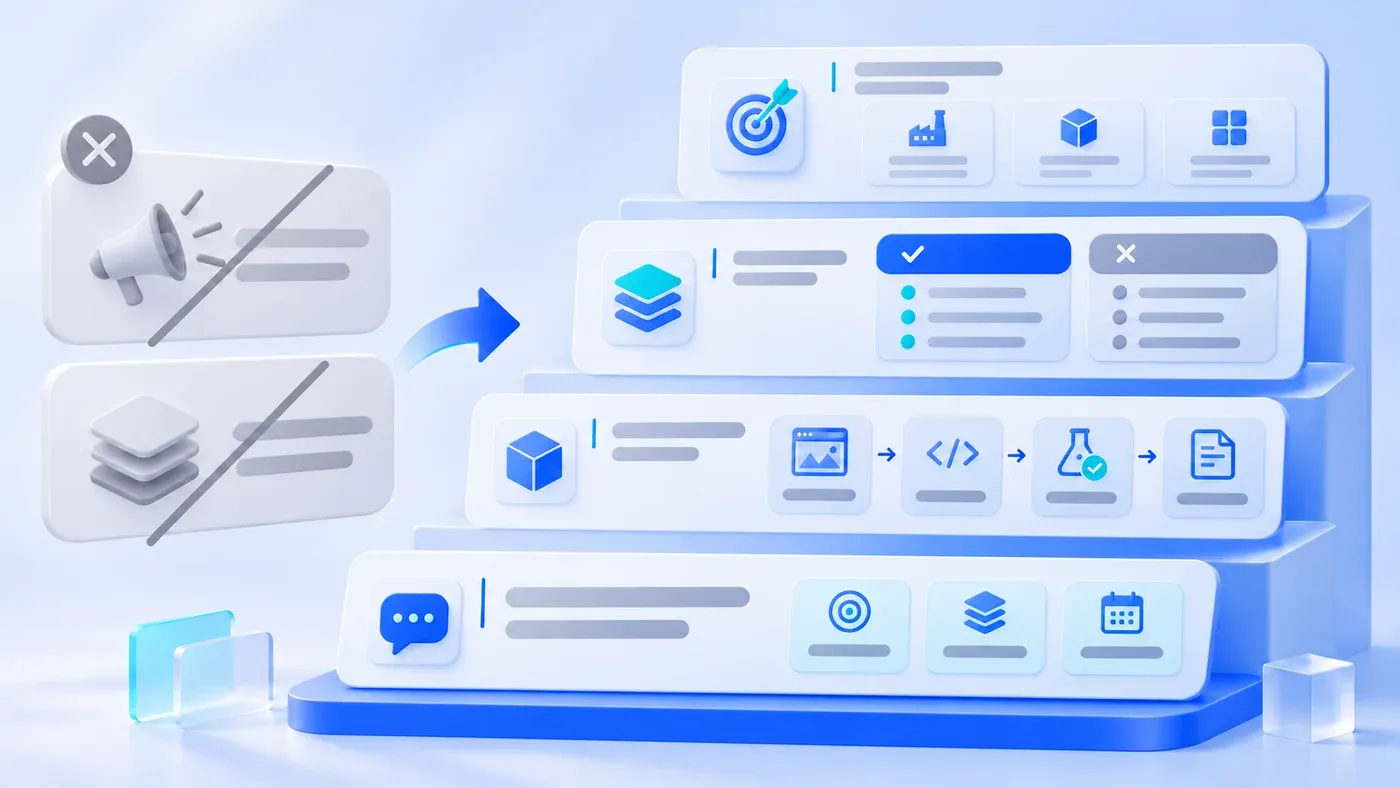
Unlike standardized hardware or off-the-shelf SaaS products with fixed SKU tables, non-standard B2B services are scoped project by project. You cannot put an "Add to Cart" button on bespoke engineering or custom software development. However, custom scoping is no excuse for vague copywriting. A clear B2B service page helps prospective clients self-qualify by defining four boundaries: which client situations and project stages fit best, what work is explicitly included and excluded, what tangible deliverables appear at each phase, and the minimum materials required before the first conversation.
Why "End-to-End Customization" Drives Qualified Buyers Away
When teams draft service pages, they often worry that being specific will narrow their market. Out of fear of turning away a lead, they stretch every sentence to cover every scenario—"full-lifecycle support, tailored to any industry." In real B2B evaluation, overly broad claims create friction rather than confidence:
- Buyers cannot tell if you solve their specific problem: "Custom software development" could mean consumer promotional mini-programs, factory floor production tracking, or embedded firmware. Claiming you build "everything for every industry" forces the buyer to guess whether you understand their operational reality.
- Project coordinators cannot estimate internal effort: Custom service delivery is never a black box where the client pays an invoice and disappears. If a page never mentions what inputs the client must supply or which milestones require sign-off, the coordinator cannot judge whether their internal team has the bandwidth to collaborate.
- Visitors fear high-pressure sales follow-ups: When a page hides all substantive scope details behind a mandatory contact form, buyers assume the page exists solely to harvest phone numbers for cold calling.
As Google Search Central's guide on creating helpful, reliable, people-first content emphasizes in its quality self-assessment, people-first pages should provide a substantial, complete description of the topic so visitors leave feeling they have learned enough to achieve their goal—rather than feeling forced to search again for real answers. On a B2B service page, the visitor's goal is to verify alignment: "This team's scope matches our current bottleneck, and I know what will happen if I reach out."
Four Clear Boundaries That Give Buyers Confidence to Inquire
- Relevant situation
- Included and excluded scope
- Stage deliverables
- Inputs for a first discussion
To make a non-standard service tangible to decision-makers and credible to technical evaluators, structure your service page around the four checks a buyer performs before clicking the consultation button.
1. Client Situations and Starting Points: Help Visitors Recognize Themselves
Instead of listing broad industry verticals ("Serving manufacturing, retail, and finance"), describe the operational situations or project stages that trigger a client to hire you. Break your ideal client fit into three concrete starting points:
- Building from scratch: "You are launching a new business line or entering an overseas market with only slide decks and scattered product sheets, and need to structure your site architecture, messaging, and inquiry flow from the ground up."
- Replacing or modernizing legacy assets: "Your existing website or internal workflow tool is three to five years old, no longer reflects current offerings, breaks on mobile devices, and needs a structured rebuild without losing valuable historical URLs or records."
- Targeted capability expansion: "Your core platform is running, but you need a dedicated partner to deliver a self-contained module—such as an English standalone site, an interactive campaign page, or a custom workflow integration."
It is equally helpful to state when a lighter alternative makes more sense. Explicitly noting that "teams looking for a standard plug-and-play accounting subscription without custom workflow rules will be better served by an off-the-shelf SaaS tool" builds credibility and saves your team from mismatched discovery calls.
2. Scope Boundaries: State What Is Included, Optional, and Out of Scope
Scope ambiguity is the top source of friction in project-based services. Breaking your service into modular workstreams—and openly stating what is standard, what is optional, and what remains the client's responsibility—signals operational maturity.
On our Corporate Website & Standalone Site Services page, rather than promising a vague "turnkey website," we break the work into five explicit areas: Content & Structure, Page & Interaction Design, Website Development, Content Management & Integration, and Search & Launch Readiness. Clarify three tiers on your service page:
- Core included workstreams: Foundational steps covered in a standard engagement (requirements structuring, wireframing, visual design, responsive development, and pre-launch verification).
- Optional add-on modules: Capabilities scoped in when needed rather than forced into every quote (bilingual copy localization, legacy article migration, or custom 3D and interactive visuals).
- Explicit exclusions and client dependencies: For example, "Domain registration and cloud hosting accounts remain under the client's corporate entity so you retain full ownership; we provide configuration guidance and deployment," or "Industry-specific legal compliance sign-off remains with the client's internal counsel."
3. Phase Deliverables: Turn an Intangible Service into Visible Milestones
Because a custom service does not exist as a finished product before contract signing, buyers hesitate when they cannot picture what they receive along the way. Replace generic stage labels with the concrete artifacts, previews, or sign-off items delivered at each phase (and link to your dedicated Delivery Process page for the full sequence):
- Discovery & Architecture Phase: Documented sitemap, page-by-page content inventory, and a scope matrix separating Phase 1 essentials from Phase 2 extensions.
- Design & Interaction Phase: Interactive layout prototypes, key visual design boards, and responsive state specifications across desktop and mobile before coding begins.
- Development & Verification Phase: Accessible staging preview environment to test form submissions, role permissions, mobile touch targets, and legacy URL redirects.
- Launch & Handoff Phase: Production deployment, source repository handoff, CMS editorial guides, and administrator role configuration.
4. Minimum First-Call Inputs and Next-Step Expectations: Remove the Fear of a Hard Sell
Answer two practical questions right beside the inquiry entry point: What is the minimum information I need for our first conversation? And what happens after I submit?
- Lower the preparation barrier: Tell visitors explicitly, "You do not need a finalized 30-page RFP to start talking with us. Simply share your current URL (if applicable), the top one or two operational problems you want to solve, and any timeline constraints."
- Set realistic response expectations: Explain the workflow: "Once you submit the consultation form or message us via WhatsApp (for international teams) or WeCom (for domestic China teams), our team reviews your context to confirm scope fit and schedules a focused 20-to-30-minute scoping call."
As we detail in How Corporate Website Content Generates B2B Leads, turning reader trust into an inquiry requires passing clear context to the receiving team while keeping the initial action low-friction.
Rewrite Comparison: Vague Service Claims vs. Evaluable Scope Statements
The table below contrasts common vague phrasing with concrete alternatives across hypothetical examples from three B2B service sectors:
Page Section | Vague Service Page Copy (Hard to Evaluate) | Evaluable Service Page Copy (Hypothetical Examples Buyers Can Self-Qualify Against) | Decision Question Solved |
|---|---|---|---|
Service Positioning (Hero) | "Delivering end-to-end digital transformation and custom software solutions to empower growth." | [Hypothetical Example — Custom Internal Operations System] "We turn scattered spreadsheets and chat approvals across purchasing, scheduling, and inventory into a role-based web system for desktop and mobile." | Within 10 seconds, the visitor knows this builds internal operational workflows—not consumer apps. |
Best-Fit Client Situations | "Trusted by leading enterprises across manufacturing, retail, logistics, and technology sectors." | [Hypothetical Example — Industrial Line Data Collection Service] "Built for mid-sized factories whose machines run daily, but where supervisors still copy output and downtime logs by hand—and who want to pilot dashboards on 1–2 priority lines first." | A plant manager recognizes their floor reality and sees that a 1–2 line pilot is welcome. |
Scope & Boundaries | "Our dedicated experts handle everything from initial consulting to long-term maintenance." | [Hypothetical Example — B2B Trade Show & Brand Visual Service] "Includes core visual concepting, booth elevation graphics, and print-ready files for 5 collateral formats. On-site carpentry and venue permitting are executed by your local booth contractor." | Marketing leads see where design ends and contractor work begins, preventing misunderstandings. |
Phase Deliverables | "Agile methodology ensuring rapid, high-quality delivery on time and on budget." | [Hypothetical Example — Bilingual Corporate Website Service] "Delivered across four review gates: Scope & Sitemap Sign-off → Wireframe & Visual Review → Staging Preview Check → Production & CMS Handover, with independent locale publishing controls." | Project coordinators see the exact sign-off gates and confirm editors can maintain bilingual copy post-launch. |
Consultation CTA | "Fill out the form now to get a 1-on-1 free consultation and exclusive discount quote!" | [Hypothetical Example — Technical Scoping Entry] "Not sure whether to rebuild your whole workflow or fix one bottleneck first? Share your current process notes or site link—we will map out a realistic Phase 1 scope together." | Eliminates the fear of reaching out "too early" and reassures the buyer they will get a scoping discussion. |
Ready-to-Use B2B Service Page Structure Template
Use the single-page blueprint below to organize your service page content before moving into visual layout:
[B2B Non-Standard Service Page — Single-Page Content Template]

1. Hero Section: State What You Do and Who It Helps
- Service Title (clear buyer terminology rather than internal jargon):
- One-Sentence Value Proposition (For [target role] + turning [current bottleneck] + into [concrete outcome]):
- 3–4 Core Capability Tags (e.g., Content & Sitemap Structuring / Responsive Development / Bilingual CMS Setup):
- Primary CTA & Secondary Link (e.g., Discuss Your Project Scope / View Preparation Checklist):

2. Best-Fit Client Situations (Who This Is For)
- Situation A (New Build / Launch): Current stage, missing pieces, and what Phase 1 solves
- Situation B (Legacy Upgrade / Redesign): What is broken in the current setup and how migration is handled
- Situation C (Targeted Expansion): Existing foundation and the specific module this service adds
- Fit Boundary Note (When an off-the-shelf tool or lighter approach is recommended instead):

3. Work Scope & Explicit Boundaries (Included vs. Excluded)
- Workstreams 1–4: [Module Name] — Specific actions performed and problem solved
- Scope Boundary Summary: Included by default / Optional add-ons / Handled by client or third parties

4. Collaboration Phases & Tangible Deliverables
- Phase 01 [Name]: Client input needed → Concrete document or scope artifact delivered
- Phase 02 [Name]: Key review checkpoint → Concrete prototype or design artifact delivered
- Phase 03 [Name]: Verification method → Staging environment or functional build delivered
- Phase 04 [Name]: Handover package (source files, CMS roles, operating guide) & post-launch support

5. Relevant Project Evidence (Selected Case Examples)
- 2–3 real project cards showing initial client context, exact workstreams delivered, and verifiable outcomes (no fabricated metrics)

6. First-Call Preparation & Low-Friction Inquiry CTA
- Minimum inputs for a first call (2–3 easy items, e.g., current URL, top bottleneck, target timeline):
- Items NOT needed yet (e.g., full technical specification, final copy for every page):
- Contact Channels: Consultation Form (share project context) / WhatsApp or WeCom (quick initial scope check)
Structuring your service page around these six blocks replaces empty adjectives with operational clarity—helping the right clients reach out faster while saving your team from repetitive scope explanations. If you are planning a new service site or restructuring existing pages, explore our Corporate Website & Standalone Site Services to see how we apply this structure, or bring your current service page draft to our consultation page to discuss your next redesign.
