
Key takeaway
The first chain must run end to end with a clear input, process, result, and closing state. Choose a frequent chain with clear boundaries, reversible failure, few dependencies, and willing users. Do not pick an isolated module or the hardest core. Agree how the old process runs in parallel and when it exits.
Suppose the following happens. Phase one launched customer management. Customer records were entered smoothly, and sales were willing to use it. But quotes stayed in the old system, orders stayed in the old system, and so did shipping and payments. Sales looked up the customer in the new system, switched to the old one for the quote, then returned to add a follow-up note. The two systems ran in parallel for six months, and nobody proposed a date to retire the old one.
The module shipped; the business did not close. The usual mistake in phased release is reading "what to build first" as "what is easiest to build" rather than "which business can run from start to finish."
The first chain must be able to end
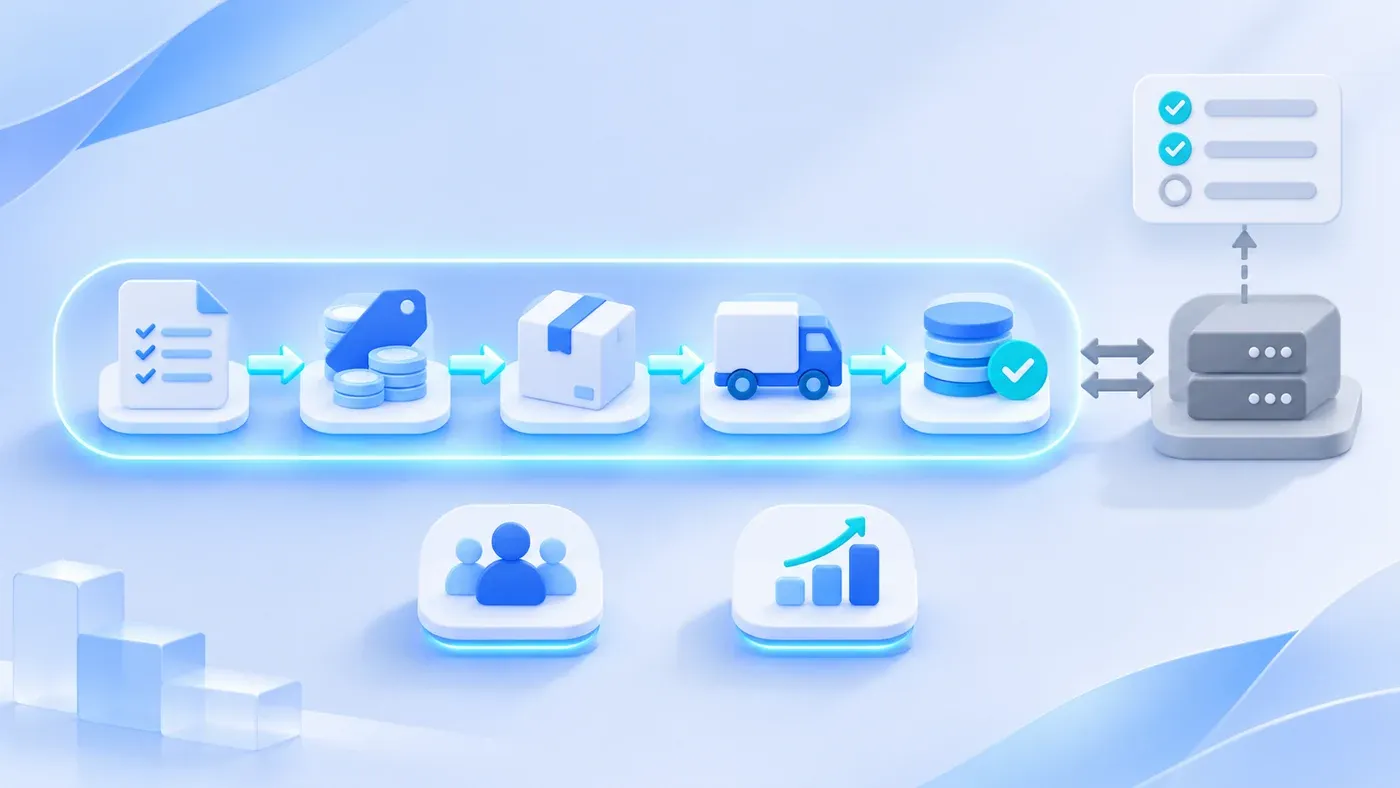
A usable first chain has four parts: a clear input, processing inside the system, a checkable result, and a defined closing state.
Take "quote to order": the input is customer requirements and a product list; processing covers quoting, approval, and customer confirmation; the result is an order with a locked price; the closing state is either awaiting shipment or cancelled. The whole chain runs in the new system, and staff do not switch back to the old one for the same piece of work.
If phase one covers only a segment while the ends remain in the old system, staff must carry data across. That brings duplicate entry, mismatched numbers, and unsynchronized status until everyone returns to the old system and the new module becomes a burden.
Five selection criteria
Closure: one piece of work completes end to end, not a single screen.
Frequency: it happens daily or weekly, so phase one gets enough usage to reveal problems. A chain that occurs a few times a year will not produce feedback.
Clear boundaries: roles, rules, and exceptions are manageable. A chain spanning five departments with disputed rules is not a first release.
Reversible failure: when something goes wrong, the business can fall back to the old process or a manual step without irreversible loss.
Willing users: at least a few frontline people will use it in real work, not because a memo requires it.
Not every criterion must be perfect, but closure and reversibility are the floor. Without them, phase one risks becoming a demo.
Do not start with the easiest isolated module
Customer management, product catalogs, and dashboards are often "easiest" because they stand alone with simple rules. But they do not close a business loop, and shipping them alone does not change how people work.
Dashboards are especially misleading: exporting old-system data into a new dashboard looks like phase-one progress, while the new system carries no business action, the data is still old, and the problems remain in the old process.
If foundational data must come first, call it a preparation stage and agree when it connects to a business chain. A preparation stage should not be presented as the system going live.
Running old and new in parallel, and exiting
Phased release means a period of parallel running. Parallelism needs a deadline and exit conditions, or it becomes permanent.
Write down the parallel mode: is each piece of business done in one system or both; which is authoritative; how the two are reconciled; who wins a difference. The worst pattern is "enter in both and use whichever is convenient."
Exit conditions can be set by business type, branch, or period: for example, the new chain runs four consecutive weeks, acceptance tasks pass, and reconciliation differences stay at zero for three weeks, then the old entrance closes. Keep read-only access for a period to look up history.
Count the staffing during parallelism. Doing the same work twice lowers speed and raises errors. If unavoidable, parallelize one step rather than the whole chain.
Exceptions and fallbacks
The first chain will meet cases it does not cover: special discounts, split orders, payment methods outside scope. Agree before launch: transfer to a person, return to the old system, pause intake, or record and handle later.
A fallback is not just "use the old system." Record every exception and review the count regularly. Too many exceptions indicate a poor chain choice or rule design, not uncooperative staff.
System failures also need a temporary plan: printed lists, offline records, backfilling after recovery. Backfilling must avoid duplicates, using business numbers or time windows.
A phase table
Candidate chain | Closes | Frequency | Dependencies | Reversible | Willing users | Decision |
|---|---|---|---|---|---|---|
Quote to order | Yes | High | Products, prices, approval | Yes, back to old flow | Sales team | First release |
Receiving to payment | Yes | Medium | Procurement, warehouse, finance | Partly; payment is irreversible | Procurement and finance | Phase two |
Service to refund | Yes | Medium | Service, warehouse, finance | Refund needs care | Customer service | Phase two |
Customer records only | No | High | None | Yes | Sales | Preparation, not a launch |
The phase table does not replace a project plan; it answers only what phase one covers. Later phases can adjust while running, but the first choice should be fixed before work starts.
A first-chain checklist
[First-phase business chain checklist]

1. Closure
- What the input is and who provides it:
- Which processing happens in the system, and where the result is checked:
- What the closing state is and who confirms it:

2. Fit
- How often the chain occurs:
- Which roles and exceptions it involves:
- Whether failure can fall back, and the worst consequence:
- Which frontline people will use it first:

3. Parallel and exit
- How old and new run in parallel, and which is authoritative:
- How differences are reconciled and how often:
- Exit conditions and date for the old entrance:

4. Fallback
- How uncovered exceptions are handled:
- The temporary plan for a system failure:
- Who reviews exceptions and failures, and how often:
Draw your most common business chain, from customer request to payment received, and mark which system each step lives in today. If phase one cannot connect that line, narrow the scope until it can. How to map current flows is covered in the system preparation guide; when writing phases into business system development, agree the parallel period and exit conditions first.
Mapping a workflow before automation is covered in map the workflow before automating it; that article does not decide release order. Phased release is not breaking a big system into small pieces; it is making each phase complete one piece of work independently.
