
Key takeaway
Copying production data is possible, not advisable. Tests need normal, boundary, missing, duplicate, permission, and volume cases, which synthetic data can cover with the same schema. If real data is necessary, minimize, mask, isolate, limit retention, and audit. Disable real email, SMS, payment, and API exits.
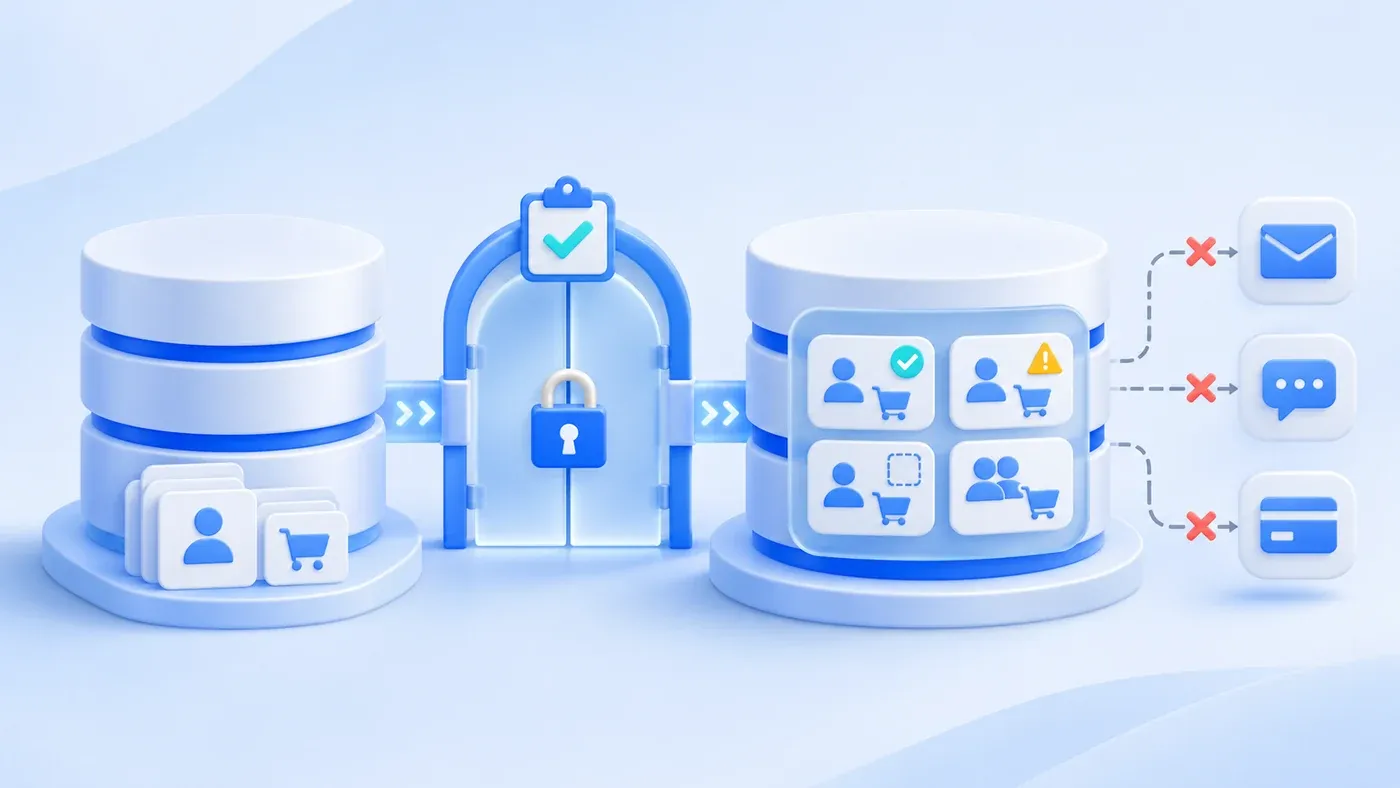
Suppose the following happens. Before a new system launch, the test lead decides the test database has too little data to reproduce edge cases, so the team copies the production database into the test environment. Testing goes smoothly. The next day, customer service gets a call: why did I receive an "order shipped" text when I have not ordered anything? Elsewhere, a tester clicks Refund, and money actually returns to a real account.
The problem is not testing. It is two boundaries: test data came from a source it should not have, and the test environment never cut off real external exits.
Copying production is possible, not advisable
Production holds customer names, phone numbers, addresses, orders, and payments. Copying it into test puts another copy in an environment with looser permissions, fewer logs, and more casual cleanup.
The risk is not only leakage. Test environments often connect to real email, SMS, payment, or logistics services. A trigger sends a real message or moves real money. Testers also cannot tell which records are safe to edit, and bad edits can break later reconciliation.
Tests need representativeness, not a full copy
Good test data covers scenarios rather than replicating production. At least six kinds:
- Normal main path: one complete piece of business from start to finish with complete data.
- Boundary values: amount exactly at the approval line, quantity exactly above stock, dates crossing month or year.
- Missing and exceptional: required fields empty, attachments missing, status inconsistent.
- Duplicates and conflicts: repeated keys, multiple records for one customer, concurrent edits.
- Roles and permissions: different roles see different fields and record scopes.
- Volume: lists, paging, and exports near real scale, to test performance and empty results.
None of these requires real names and phone numbers. What matters is truthful structure and relationships: orders attach to existing customers, lines correspond to orders, permissions map to roles and organizations.
How to build synthetic data
Copy structure, not content: tables, fields, enums, constraints, and relationships match production.
Then generate content: customer names obviously fictional, phone numbers from reserved ranges or clearly fake, addresses in a test park, amounts covering normal, boundary, and exceptional ranges. Fix the random seed so every rebuild produces the same data and problems are reproducible.
Keep relationships consistent: an order's customer, products, prices, stock, and approver must resolve; no order may reference a missing customer, and no approver may lack a role. Run an integrity check after generation.
Label the data: test customers carry a "TEST" prefix, test orders carry a fixed source marker, test attachments use placeholder files. Logs, screenshots, and exports then show at a glance that this is not real business.
If real data is genuinely necessary
Some problems only appear with real data: address formats, historical dirt, extremely long text, special characters. Real data may be used under controls:
Minimize: take only the needed fields and record range; do not copy the whole database. If testing needs no identity number, leave it out.
Mask: replace names, phones, addresses, ID numbers, and bank accounts with fake values while preserving format and length so validation still works. Sample-check after masking to confirm relationships remain intact.
Isolate: deploy a separate test database with separate accounts, restrict access by source, do not share connections with production, and let testers request access rather than granting everyone read by default.
Retention and audit: agree how long test data is kept and how it is deleted; record who exported or accessed it. Real data should not sit in a test environment indefinitely.
Which fields count as personal information, and how long they may be kept, requires confirmation by the data owner under applicable requirements. This article provides operational checks, not a legal conclusion.
Cut off external exits
The most common oversight is leaving email, SMS, payment, logistics, and webhooks pointed at real services. Check each before launch:
- Email and SMS use a test channel or sandbox, with recipients limited to internal addresses.
- Payments, refunds, and invoicing use a sandbox and test merchant credentials.
- Logistics orders and shipping labels use a test account.
- Outbound webhooks point at a test receiver, not a customer or partner address.
- All outgoing content carries a TEST marker so it cannot be mistaken for a real notice.
If the system cannot switch to a sandbox, disable outbound sending in test and record to a log or test inbox. Disabling needs an explicit switch and a check record, not a tester who remembers not to click.
Assign an owner to the test environment itself, not only to the test data. Someone must decide who can copy data in, how long it stays, and who approves access. Review the environment before each release and after each project; stale copies of production are a common leak path. If a vendor hosts the environment, confirm deletion in writing and keep the confirmation with the project records. The owner also decides when the environment is rebuilt from scratch.
A test data and environment checklist
[Test data and environment checklist]

1. Coverage
- Are normal, boundary, missing, duplicate, permission, and volume cases present:
- Are relationships complete, with no orphan records:
- Is volume close to real scale:

2. Source
- Synthetic or real data, and why:
- Is real data minimized, masked, and sample-checked:
- Retention period and deletion method:

3. Isolation
- Separate test database and accounts:
- Who may access or export test data, and is it recorded:
- Network and credential separation from production:

4. External exits
- Do email, SMS, payment, logistics, and webhooks point at test channels:
- Where switching is impossible, are they disabled and recorded:
- Does outgoing content carry a test marker:
Trigger one deliberate test in the environment: submit a test order and see where the SMS goes, which account receives the refund, and who gets the webhook. If any exit points at a real customer or real money, the environment is not ready. Data cleaning and migration are separate work; this article covers test data only. How far a test environment must be verified is covered in the task-based acceptance discussion within business system development.
