
Key takeaway
Separate branch-owned records, shared master data such as products and prices, and consolidated reporting. Scope follows business ownership, not who typed the record. Shared data needs one maintaining owner and change notices. When a branch opens, merges, or closes, check records, accounts, and shared data.
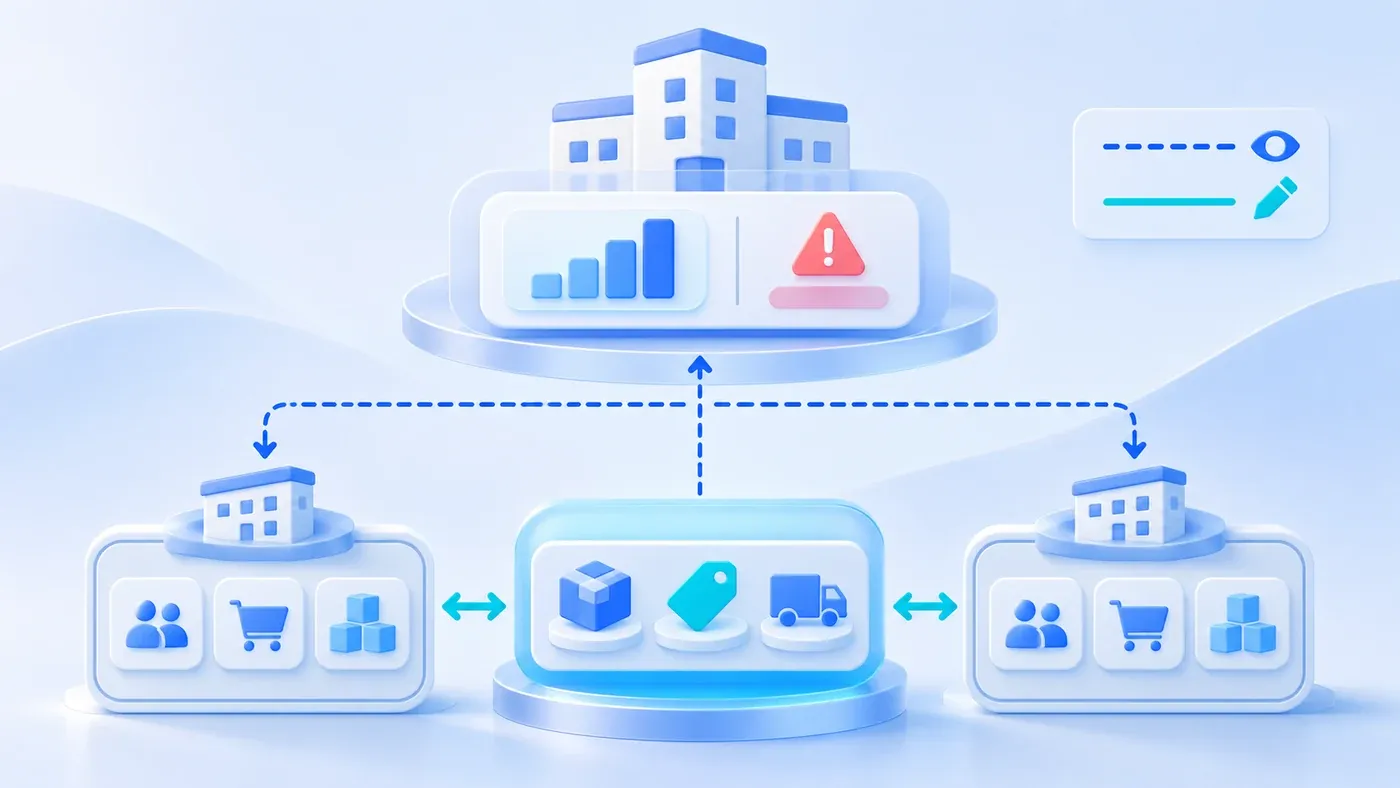
Take this illustrative scenario. Two branches share one admin system. A salesperson in branch A opens the customer list and sees every customer and deal in branch B. Branch B updates its price list, and the next day branch A discovers its quotes use the new prices. At the month-end meeting, the two managers accuse each other of overreach, but nobody can say which data was supposed to belong to whom.
Sharing one system does not mean pooling all data. Answer one question first: is this record a branch's own business record, a company-wide reference, or something that should appear only in consolidated reporting?
Three kinds of data, three scopes
Business records: customers, orders, quotes, stock, payments, service tickets. These usually belong to a branch or business unit. Branch A's customers should not appear in branch B's list by default.
Shared master data: product catalog, pricing policy, suppliers, material codes, contract templates. Headquarters or a named department maintains one version, and every branch uses it. Prices may differ by region or customer tier, but the differences should be rules, not separate copies.
Consolidated reporting: revenue, order volume, stock turnover, exception alerts for headquarters. Headquarters sees totals and exceptions by default; individual records require authorization or an approval.
Mixing the three is the usual source of branch-system chaos. If the customer list is designed as "visible to all," business records leak. If price lists are designed as "each branch maintains its own," shared data splits.
Scope follows ownership, not who typed the record
Every customer record needs an owning branch field. Not "whoever entered it owns it." If a person transfers from branch A to branch B, the customers they entered still belong to A; only new customers entered at B belong to B.
Ownership can follow a rule: the store of first purchase, the contracting entity, or the branch of the service owner. Pick one primary rule. Do not have two fields both called "owner" that different reports interpret differently.
Records can move between branches, but the move leaves a trace: who requested it, who approved it, from which branch to which, and whether historical orders move too. A transfer is not a single field change; related quotes, service, and payment scope need considering.
Personal visibility also needs defining: sales see their own accounts, store managers see their store, regional managers see their region. Role and record scope are separate. The same "store manager" role sees different data in different branches.
Who maintains shared data
Product, price, and supplier data needs a maintaining owner. A central product team maintains the catalog, finance maintains tax and settlement rules, procurement maintains suppliers. Write the owner for each field so "everyone can edit" does not become "nobody is responsible."
Changes to shared data need announcing. When a price change takes effect, how long the old price stays valid, and whether issued quotes use the old or new price must be rules. The system can show affected branches and open documents at the moment of change, instead of applying it silently.
If branches genuinely need different prices or product ranges, use "shared catalog plus branch applicability" rather than a fully separate copy. Copies split product codes and break consolidation.
Headquarters detail access and branch acting on behalf
OWASP least-privilege guidance informs implementation; the business must still define who may access another branch.
Headquarters sees summaries by default, not every detail. Looking at an individual order goes through authorization or approval and leaves a record. This is not distrust; it makes "who looked at what, when" answerable.
Cross-branch coverage needs rules too. If branch A temporarily handles service for branch B, B grants named people in A a temporary authorization limited by customer scope, actions, and time. It expires automatically rather than becoming permanent.
A group customer that buys at two branches needs one primary owner and a collaborating branch. The primary owner maintains the master data; the collaborator sees the orders belonging to its own branch for that customer. Do not solve collaboration with "everyone can see everything."
Opening, merging, or closing a branch
Opening: create the organization, roles, record scope, shared-data applicability, and approvers. Do not copy another branch's permissions wholesale.
Merging: decide which organization survives, migrate record ownership, resolve duplicate customers and prices, then retire the old organization. Back up and sample-check before migrating.
Closing: settle open orders, service, and receivables, reclaim accounts, then retire the organization. Historical records must not vanish when a branch closes; reporting should still work on historical ownership.
A data scope table
Data type | Owner | Who may view | Who may edit | Cross-branch exception |
|---|---|---|---|---|
Customers and contacts | Owning branch | Related roles in that branch | Branch owner | Group customers maintained by primary owner |
Orders and quotes | Owning branch | Related roles in that branch | Branch handler | Acting on behalf needs temporary authorization |
Stock | Warehouse or branch | Local warehouse and sales | Warehouse role | Headquarters sees totals |
Products and prices | Headquarters or named department | All branches | Designated maintainer | Branch differences expressed as rules |
Suppliers | Procurement | Procurement and finance | Designated maintainer | Branches may not create duplicates |
Consolidated reports | Headquarters | Management | Not directly editable | Detail access requires authorization |
Check the current system against this table: which rows are "visible to all" today, and which have multiple conflicting maintainers. Every finding becomes a written rule, not a verbal agreement.
How to express roles and permissions in one matrix belongs to the business system development scope; this article covers only branch ownership. Why SaaS multitenancy isolates customer data the way it does is explained in why SaaS is multi-tenant. That article does not resolve internal branch boundaries.
