
Key takeaway
Handoff is a designed exit, not a failure. Use five triggers: missing information, repeated failure, permission or high-risk actions, explicit customer request, and special situations or strong sentiment. Pass the customer's words, confirmed facts, attempted steps, and order context; offer queue or callback fallback.
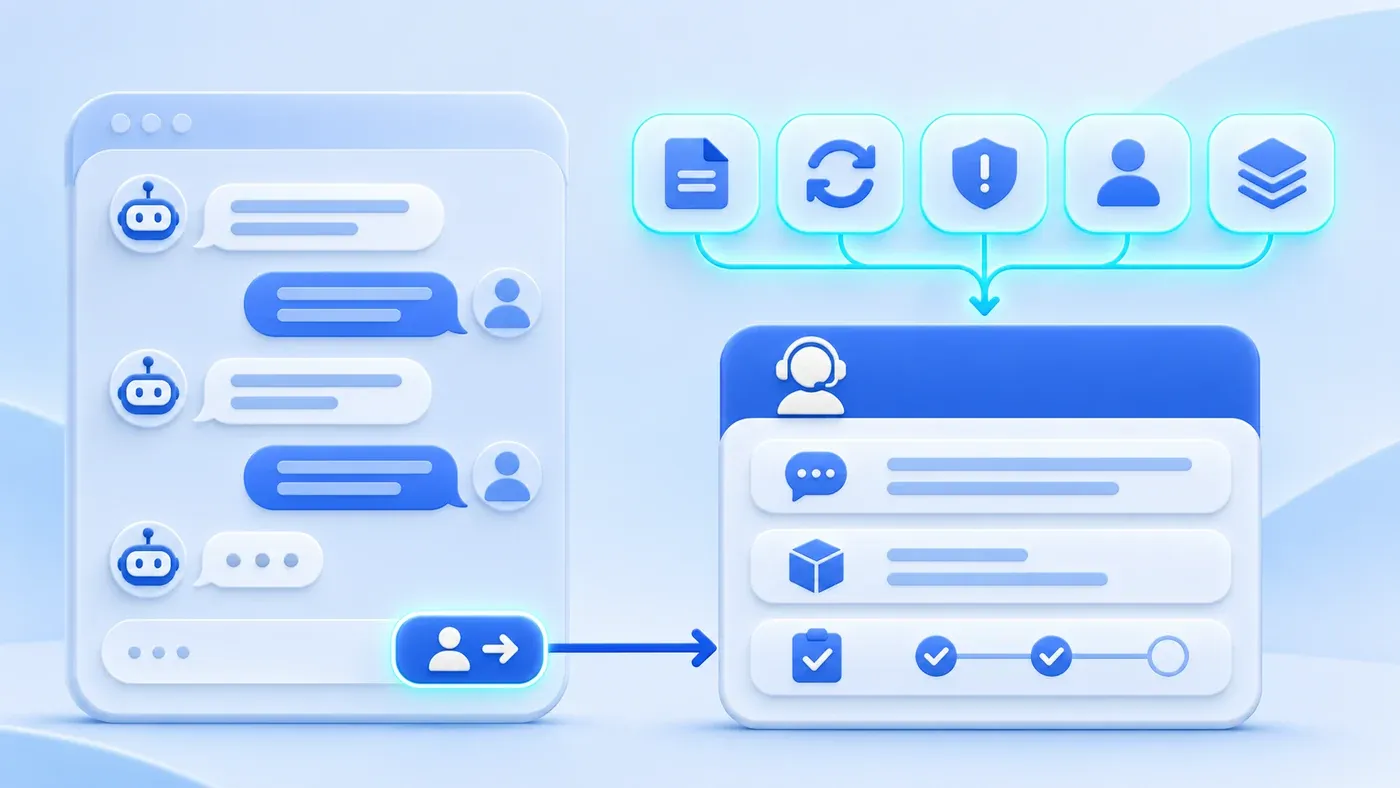
Consider a hypothetical case. A customer types: "Human agent." AI replies: "I can help with that. Please describe your issue." The customer types: "I want a person." AI replies: "I am happy to help. Please provide your order number first." The third time, the customer closes the window and calls to complain.
AI may well know how to handle the issue; it may even know the answer. The problem is that the system treats continuing the conversation as the only goal and has no explicit exit. The customer has expressed the need as directly as possible, and the system is still running its own script.
Handoff is an exit, not a failure
Guideline G8 supports dismissing unwanted AI services. The five handoff triggers below are design recommendations.
Automated service should solve common questions, collect necessary information, and route complex issues to the right person. It should not aim for "never hand over." A customer service system that never hands over usually means one of two things: every problem has been simplified, or customers have given up.
Handoff needs explicit triggers, handover content, and follow-up ownership. It is a process step, not a catch-all button.
Five triggers
One: missing information. AI cannot find the order, customer, policy, or product information and has no evidence-based answer. More questions only make the customer repeat themselves.
Two: repeated failure. The same issue remains unsolved after two or more attempts, or the customer is clearly repeating the same sentence. Do not try a fifth phrasing.
Three: permissions or high-risk actions. Refunds, address changes, cancellations, account changes, compensation promises: AI lacks permission, or the result is irreversible. Route these immediately instead of chatting for ten minutes first.
Four: explicit request. When the customer says "human," "real person," or "manager," hand over promptly. Confirm once ("I am transferring you now"), but do not keep persuading.
Five: special situations or strong sentiment. Safety, legal, media, group complaints, or strong dissatisfaction and threats to complain: hand over and escalate. AI should not promise an outcome.
The five are not exclusive. One conversation may trigger several; follow the strictest.
What the handoff carries
The worst handoff makes the customer start over. Carry at least:
- The customer's words: key sentences verbatim, not only an AI summary.
- Confirmed facts: order number, customer identity, issue type, noting which the customer confirmed.
- Attempted steps: what AI asked, what the customer answered, which options are ruled out.
- Related records: order status, ticket history, refund progress.
- Trigger reason: missing data, customer request, or high-risk action.
The agent's screen should show these at once, without switching systems. Keep the handoff record for later review.
Do not use handoff to avoid answering
Some systems hand over whenever a question is slightly complex, flooding the human queue and making customers wait longer. Handoff should happen when AI genuinely cannot act safely, not when it is merely unsure.
Write the rule: if the data contains a clear answer, the action is low-risk, and the customer has not asked for a person, AI answers first. If the answer involves permissions or an irreversible action, hand over even when the data is complete.
Fallback when staff are busy
Handoff does not mean someone answers immediately. Design queueing, callback, or messages:
- State queue position and an estimated wait, without promising an exact minute count.
- Offer callback or message, preserving the customer's words and context.
- Outside working hours, state the next response time and offer self-service lookup.
- If the customer will not wait, record the issue and provide a follow-up channel.
The fallback is not returning the customer to AI. A conversation that has triggered handoff should not loop back to the bot.
A hypothetical trigger table
Trigger | How to detect | What to pass | When staff are busy |
|---|---|---|---|
Missing information | No result or insufficient data | Searched scope, missing item | Message and promised reply |
Repeated failure | Same issue unresolved after two rounds | Full conversation and quotes | Queue or callback |
Permission/high risk | Refund, address change, cancellation, compensation | Order, requested action, risk | Priority queue, no automatic action |
Explicit request | "Human," "real person," similar | Customer's words and confirmed facts | Immediate transfer or callback |
Special situation/sentiment | Safety, legal, complaint escalation | Quotes, subject, time | Escalate to manager and record |
"Priority queue" in the table needs human confirmation; the system does not promise it automatically. Response times after handoff are set by the business; this article gives no universal number.
Closing a handed-off conversation also needs a rule. After handling, the agent records the outcome and next step before closing; a conversation should not expire silently because nobody replied. If the customer writes again, the exchange should return to the same record rather than starting over. The record should also show whether the issue was resolved, needs a follow-up, or was escalated, so the next agent does not repeat the investigation. Review closed handoffs weekly for unresolved items; that review also feeds the knowledge base and the trigger rules.
A handoff is complete only when the record says how it ended.
Carry the Right Context into a Human Handoff
[AI customer service handoff checklist]

1. Triggers
- Does each of the five triggers have a clear detection rule:
- Does an explicit request transfer immediately:
- Do high-risk actions skip multi-round chat:

2. Context
- Does the handoff carry quotes, confirmed facts, and attempted steps:
- Can the agent see orders and history on one screen:
- Is the trigger reason recorded:

3. Fallback
- Are queue, callback, or messaging available when staff are busy:
- Are out-of-hours expectations stated:
- Can a handed-off conversation return to the bot:

4. Review
- Are handoff reasons counted regularly:
- Do frequent handoffs feed knowledge or process improvements:
- Do human outcomes return to evaluation:
Take last week's handoffs and look at the reason distribution. If most are missing information, fix the data first; if most are customers asking for a person immediately, check whether AI says too much irrelevant material in the first rounds. The automated response chain is in customer service FAQ automation; permission boundaries are in AI agent permissions, approval, and human takeover. The scope of customer service AI and handoff can be discussed within AI applications and workflows.
Handle classification and routing errors before handoff. When evidence is missing, give a useful abstention rather than making the user repeat the question.
