
Key takeaway
Record approved terms, context, forbidden variants, versions, and owners. Treat brands, model codes, generic product names, and features separately: retain approved brand forms and codes, while translating generic descriptions appropriately. Use the same glossary in writing and review.
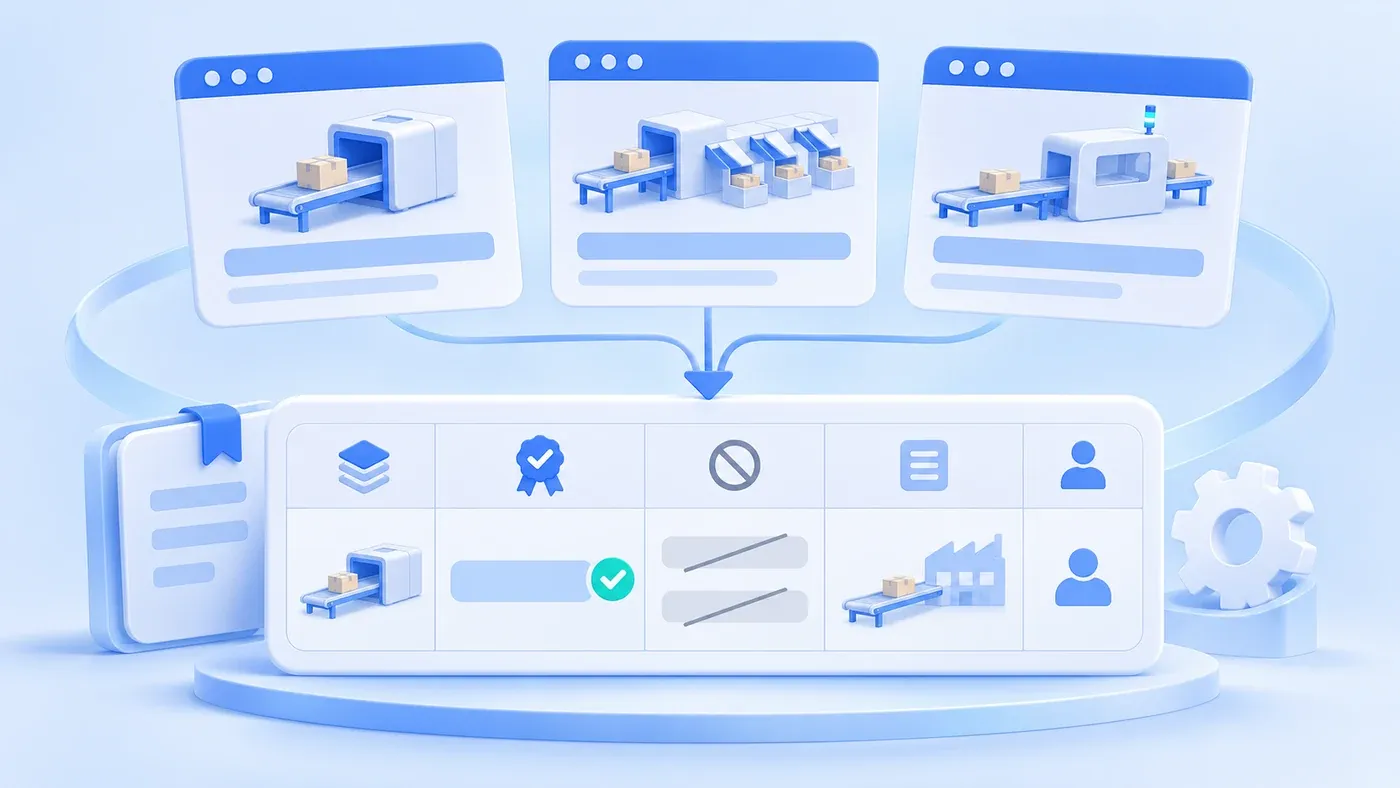
The following product-naming materials are synthetic examples, not claims about a real product or its operating capability.
One product is called "智能分拣线" (intelligent sorting line) in Chinese. The English website says Smart Sorter, the product manual says Intelligent Sorting Line, and the trade show board says Auto-Sorting System. A customer emails to ask whether these are one product or three different machines. Sales checks three documents and cannot say for certain.
Inconsistent translation is usually not a translation-skill problem. Nobody ever decided "this term is translated this way, and only this way." AI translation amplifies the problem: each run may choose a different rendering, or invent a fourth.
Terminology comes before translation
A glossary is not a comparison table produced after translation. It is the rule set fixed before translation. It answers at least: which foreign term corresponds to this Chinese term, which renderings are forbidden, in what context it applies, and who maintains it.
Without a glossary, AI guesses from context. Translating a product catalog in batches almost guarantees inconsistency.
What a glossary entry needs
An entry needs at least eight fields:
- Source term: the Chinese original, including common abbreviations.
- One approved translation: the current approved rendering.
- Forbidden translations: renderings used before but retired, with the reason.
- Part of speech and usage: noun, verb, or adjective; countable; capitalization.
- Context: product line, page type, or sentence environment.
- Example: one source sentence and one translated sentence showing real usage.
- Version and effective date: from which document version it applies.
- Owner: who may approve changes.
A two-column "Chinese–English" table fails as soon as a term has multiple meanings or product-line variants.
Handle product names, model numbers, and feature names separately
Brands and product names: use approved official forms for brands and established names; the English brand for “澄序元” is ChengXuYuan. Generic product descriptions usually need translation, so do not retain Chinese or pinyin indiscriminately. Confirm any localization of a series name with its owner.
Model numbers: never translated. Preserve letters, digits, and hyphens exactly; do not adjust case for appearance.
Feature names: translated, and consistently. For example, fix "自动分拣" as automated sorting, not alternating with auto-sorting or automatic sorting. Feature names are how customers compare products; inconsistency reads as different capabilities.
Generic descriptions: may stay flexible but still follow the glossary. Words such as "efficient" or "stable" need not map word for word, but usage within one page should agree.
Register the four categories separately so a product name is not translated as a feature, or a model number treated as an ordinary word.
Context and examples
The same word can differ by product line. "Line" in sorting equipment is line; in data connections it may be cable. State the context rather than imposing one global rendering.
Examples are the most useful part. With source term, approved translation, and an example, a translator or AI can judge usage better than from a two-column list. Examples also expose articles, plurals, and prepositions.
How the glossary enters the AI workflow
A glossary on a shared drive mentioned once in training does not exist in practice. Put it into three places:
Translation prompts: pass the relevant entries as constraints, require the approved rendering, and ask AI to flag unregistered terms instead of inventing.
Pre-publish checks: use scripts or sampling to catch forbidden translations, rewritten product names and models, and inconsistent renderings on one page.
Change records: when a term changes, old translations do not update themselves. List affected pages and documents and schedule updates rather than editing only the glossary.
A hypothetical entry
Field | Example content |
|---|---|
Source term | 智能分拣线 |
Approved translation | Smart Sorting Line |
Forbidden translations | Intelligent Sorting Line; Auto-Sorting System |
Usage | Noun phrase; title case; plural adds s |
Context | Sorting equipment line; website, manual, and booth use the same term |
Example | Source: 智能分拣线支持 24 小时连续运行。Translation: The Smart Sorting Line supports 24-hour continuous operation. |
Version and effective date | v2, effective 2026-11-16 |
Owner | Product marketing lead |
Forbidden translations are not "wrong English"; they are "no longer the official name." Keeping them lets pre-publish checks recognize old usage and prevents someone from reviving them.
How to start a glossary
Do not begin with every word in the company. Start with terms that already disagree: one product name with two or more translations, or customer service, sales, and the website each using a different label. List those terms, assign one owner per term, fix the approved and forbidden translations, then add context and examples.
Keep the first version to twenty or thirty terms covering product names, core features, common actions, and units. After publishing, let translators and content colleagues use it for two weeks and collect the terms they could not find or were unsure about. Add those in a second version. A glossary is not written once; it grows with the material it governs. Review it whenever a new product line or language launches.
Start small and keep it current.
Approve the Glossary Version Before Publishing
[Multilingual product terminology checklist]

1. Glossary
- Does each entry have source term, approved translation, forbidden translations:
- Does it state part of speech, context, and example:
- Does it have version, effective date, and owner:

2. Categories
- Do product names keep the official name instead of literal translation:
- Are model numbers preserved exactly:
- Are feature names consistent, without alternates:

3. Workflow
- Is the glossary passed as a constraint during translation:
- Does pre-publish check forbidden terms and rewritten models:
- Are affected pages listed and updated after a term changes:

4. Maintenance
- Who approves new terms, and when are old renderings retired:
- Do translators and AI use the same glossary version:
Take the product name translated most inconsistently, collect every rendering in use, register them, then check the website, manuals, and booth materials. If two names still appear on one page, the glossary has not taken effect. Model and version distinction is separate data work; English website localization is also its own topic. The scope of multilingual materials and AI translation workflows can be discussed within AI applications and workflows.
The architecture of a multilingual knowledge base is covered in how to build a multilingual enterprise knowledge base; the cold-start data list is in what data an enterprise knowledge base needs to start.
Confirm the model and version behind each term, then verify the website copy before publishing.
