
Key takeaway
Use synthetic materials, never real customer information. Keep document structure and business language realistic, but fictionalize names, contacts, and amounts. Keep entities consistent across documents and label everything as demo. Use a separate environment, expiring accounts, and post-demo cleanup.
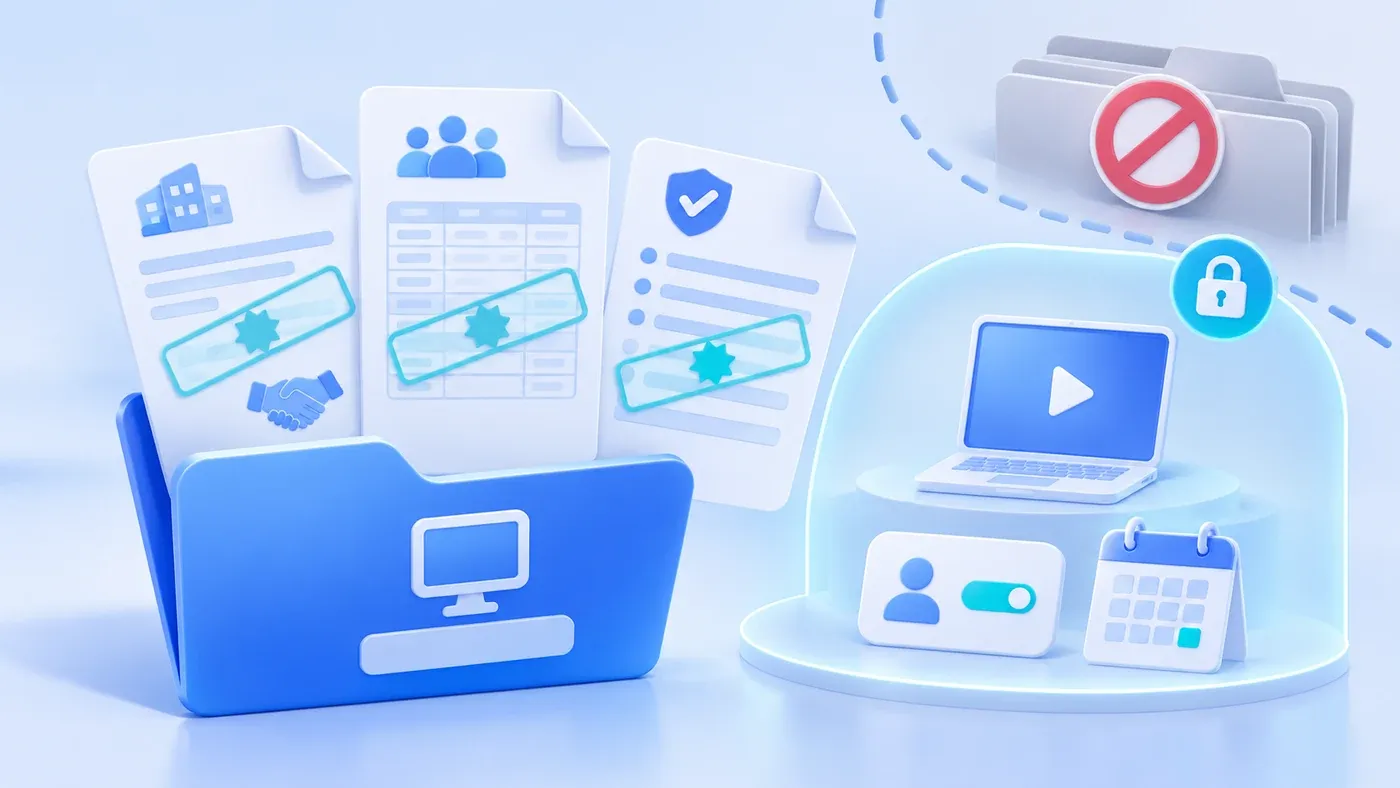
Suppose the following happens. To make a demo "more realistic," the team asks business units for three contracts and a customer list and uploads them into the demo knowledge base. The demo goes well; the customer sees the assistant answer contract clauses accurately. Afterward everyone is busy with follow-up, and nobody deletes the files. Two months later the vendor's demo account is still active, and the real contracts are still inside.
A demo knowledge base is still a knowledge base. It gets searched, exported, screenshotted, and forwarded. Once real customer information enters a demo environment, it has moved from a controlled business system into a place with looser permissions and a shorter lifecycle.
Synthetic does not mean empty
The goal of synthetic material is to keep structure while removing real identities. Document types, section hierarchy, field relationships, and business language should feel real; company names, contacts, phone numbers, amounts, and contract numbers should be fictional.
The audience then sees how the assistant handles realistically structured documents, not an oversimplified sample. And if a screenshot leaks, no real customer is involved.
Building a demo data set
List the scenarios the demo covers: product specifications, contract clauses, policy comparison, ticket handling. Prepare one or two documents per scenario.
Product manual: keep model numbers, parameter tables, and conditional footnotes; fictionalize the company and model names. Parameters must remain logically consistent—power corresponds to voltage, not random values.
Customer contract: keep contract structure, clause numbering, and party fields; fictionalize company names and amounts. Customers, products, and dates must match across contracts.
Service policy: keep applicable conditions, exceptions, and handling flows; regions and deadlines may be hypothetical but must stay consistent.
Historical tickets: keep ticket numbers, issue descriptions, and statuses; fictionalize customer details. Tickets should reference the earlier contracts or products, or linked queries will fail during the demo.
Cross-document consistency
The most common defect is not one fake document but documents contradicting each other. A contract names a model absent from the manual; a ticket's customer is missing from the customer table; a policy deadline disagrees with a contract annex.
Define master data first: three fictional companies, five fictional contacts, three product models, two regions. Every document draws from this set instead of inventing names per file.
Dates need logic too. Contract signing precedes service start, tickets fall within the contract period, and the policy version is the one the contract references. The audience will follow up, and inconsistent dates expose the demo.
Label clearly
Put a "Demo material / DEMO" watermark or header on every document, and include demo in file names. If the system supports it, the assistant keeps that marker in citations.
The label is not for the presenter; it is for everyone who may touch the file: sales, customers, vendors, and the colleague who inherits the demo environment. Even forwarded, it is recognizable as not real business material.
Environment, accounts, and cleanup
Keep the demo environment separate from production, with separate accounts and an expiry date. Demo accounts do not connect to production databases, send real email, or call real payment or logistics services.
After the demo, clean up against a checklist: delete uploaded documents, revoke accounts, clear caches and exports, and check screenshots and recordings for sensitive content. If the vendor hosts the environment, confirm how and when they delete.
Keep a cleanup record: who, when, what was deleted. "I remember deleting it" is not enough.
Keep the demo script consistent with the synthetic data
Rehearse the narration against the synthetic documents. If the presenter says the contract requires payment in 30 days, the document cannot say 45; if the presenter calls the customer a manufacturer, the customer table cannot list retail. The audience will follow up, and one mismatch lowers trust in the whole demo.
The script should also cover failure states: how the assistant answers when the material has no answer, how it presents two conflicting synthetic documents, and how it declines an unauthorized request. Demonstrating only the happy path suggests the system never fails.
If the demo invites live questions, prepare a set of likely questions and expected answers, but do not memorize them. The presenter should know which synthetic document each answer comes from and be able to open the original on the spot.
Finally, label the environment at the start: "This is a demo knowledge base built with fictional documents." Saying it once prevents the audience from remembering a test figure as a real capability. Keep a short list of what the demo does not show, such as live data, production permissions, or integrations not yet connected. Stating the boundary is more credible than implying completeness. End with the next step and who owns it.
Rehearse the opening label too, so it sounds like part of the demo rather than a disclaimer.
Inspect Demo Documents and External Connections
[AI assistant demo material checklist]

1. Material
- Are all companies, contacts, and amounts synthetic:
- Are real document structures, fields, and business language preserved:
- Are entities, dates, and models consistent across documents:

2. Labeling
- Does every document carry a demo label:
- Do file names include a demo marker:
- Does the assistant keep the marker in citations:

3. Environment
- Is the demo environment isolated from production:
- Do accounts have expiry and least privilege:
- Are real email, payment, and external APIs cut off:

4. Cleanup
- Are documents deleted, accounts revoked, exports cleared:
- Were screenshots and recordings checked:
- Is cleanup recorded, and vendor-hosted deletion confirmed:
Before the demo, have someone who did not prepare the material look through it and see whether they can tell at a glance that it is fictional. If it still looks like a real contract, the labeling is not obvious enough. Test data preparation and acceptance questions are neighboring but different problems. The scope of AI assistant demos and knowledge base preparation can be discussed within AI applications and workflows.
Boundaries before company data enters external AI tools are in four data boundaries before using AI on company material; the implementation path is in how to build an enterprise AI knowledge base.
Run the document-assistant acceptance questions on the synthetic set, including missing, conflicting and unauthorized information.
